# Thread Studio
Write X posts, threads, long posts, and Articles from your Obsidian notes, in a composer that shows you what the timeline will show.
[简体中文](README.zh-CN.md)
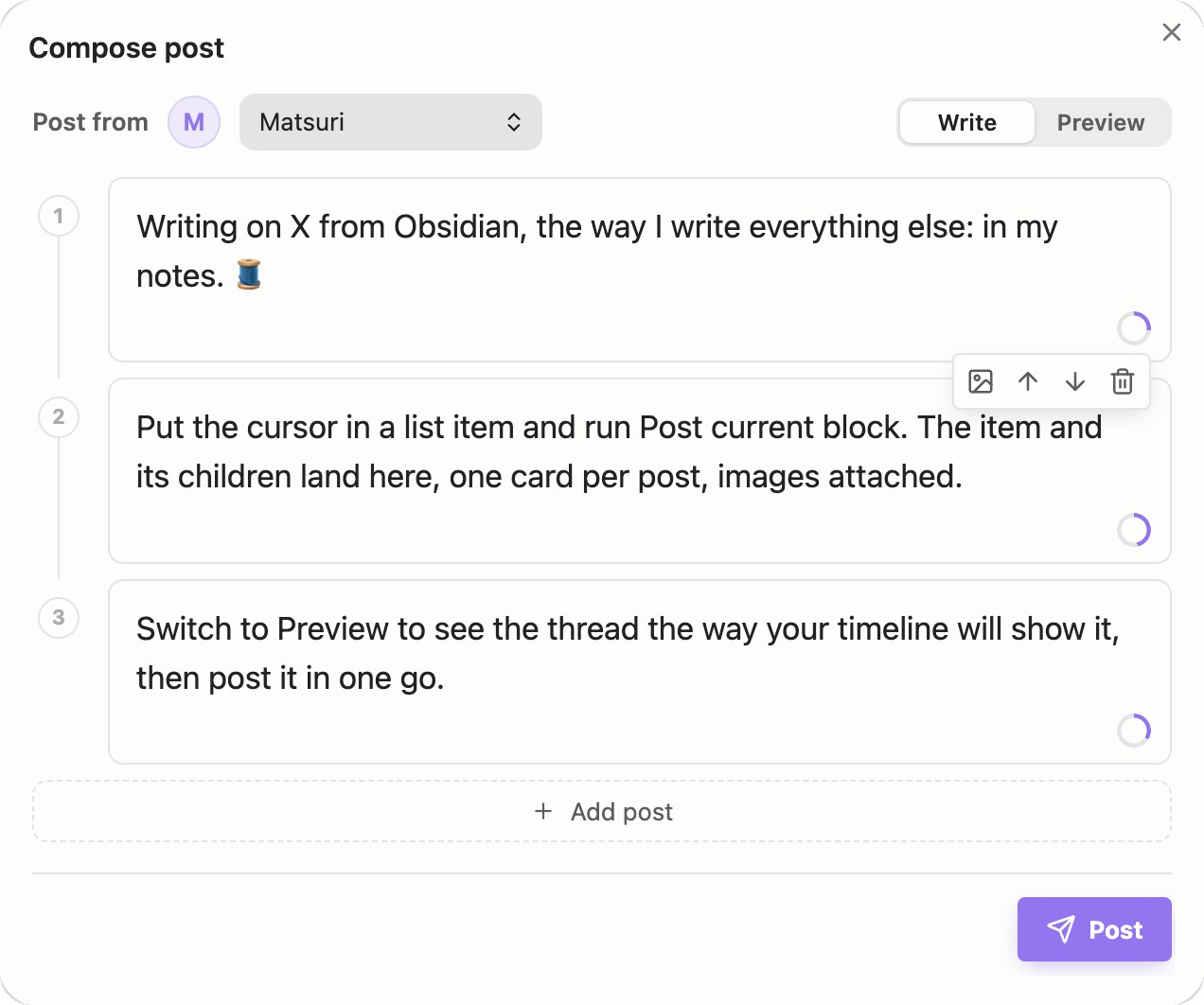
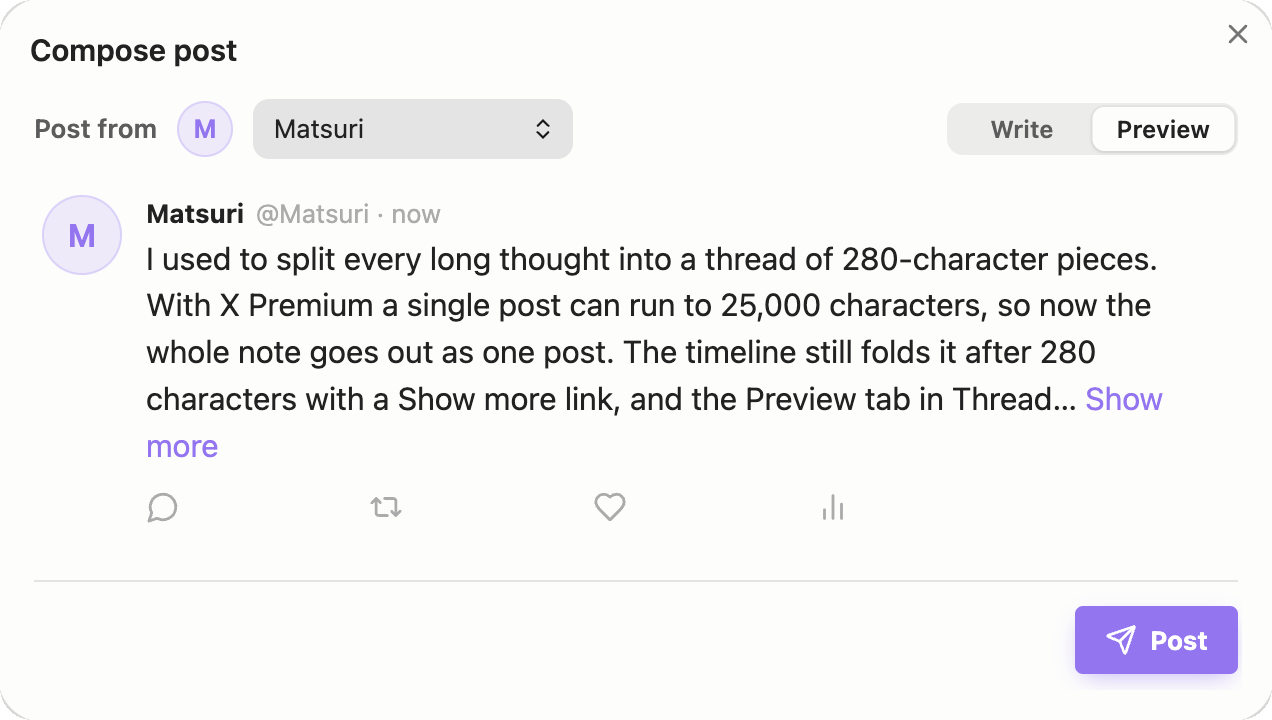
Thread Studio is a fork of [NoteTweet](https://github.com/chhoumann/notetweet_obsidian) by Christian Bager Bach Houmann, published with his consent ([chhoumann/notetweet_obsidian#76](https://github.com/chhoumann/notetweet_obsidian/issues/76)). Everything NoteTweet does still works; Thread Studio adds:
- **Write / Preview.** Preview lays the thread out the way X does: avatar, name, the thread line, image grids, and links, hashtags, and mentions in color.
- **Post current block.** Put the cursor in a list item or paragraph and run the command, click the paper plane in the ribbon, or right-click. The item and its children open in the composer, embedded images attached. Task keywords (`TODO`, `DOING`, …), wikilink brackets, emphasis marks, and `%%comments%%` are cleaned up. Once posted, the tweet tag goes on that block's first line.
- **X Premium long posts.** Turn on *X Premium long posts* and a single post can hold up to 25,000 characters instead of being split into a thread. The count shows the post's length past 280, and Preview folds it with *Show more* where X will.
- **X Articles.** *Post note as X Article* turns the active note into an Article: headings, lists, quotes, bold, italic, strikethrough, links, images, code blocks, tables, and dividers carry over. Publish it at once, or save a draft and finish it in X's editor.
- **A composer with some life in it.** A count ring that fills like X's, cards that slide into place when you add, move, split, or delete posts, icons that move when you point at them, and short, quiet sounds you can switch off. Reduced-motion settings are respected.
**Contents**
- [Installation](#installation)
- [Setup](#setup)
- [Usage](#usage)
- [Network use and accounts](#network-use-and-accounts)
- [Troubleshooting](#troubleshooting)
- [Feedback and updates](#feedback-and-updates)
- [Credits](#credits)
- [License](#license)
## Installation
Until Thread Studio is listed in the Obsidian community plugin directory:
- **With BRAT:** install [BRAT](https://github.com/TfTHacker/obsidian42-brat), run *BRAT: Add a beta plugin for testing*, and enter `MatsuriMW/thread-studio`.
- **By hand:** download `main.js`, `manifest.json`, and `styles.css` from the [latest release](https://github.com/MatsuriMW/thread-studio/releases/latest) into `/.obsidian/plugins/thread-studio/`, then enable Thread Studio under *Settings → Community plugins*.
Thread Studio needs Obsidian 1.13.0 or newer, for its encrypted Secret Storage. It can be installed next to NoteTweet: the two keep separate settings and separate credentials.
## Setup
You post through your own X developer app, so you need four keys from the X Developer Portal.
1. Sign in at [developer.x.com](https://developer.x.com) and create an App in the [Developer Portal](https://developer.x.com/en/portal/dashboard). New apps are placed inside a Project, which the X API v2 requires.
2. Copy the **API Key** (the Consumer Key) and the **API Key Secret** (the Consumer Secret) shown when the app is created.
3. Let the app post:
- In the app's **Settings**, open **User authentication settings** → **Edit**.
- Enable **OAuth 1.0a** and set **App permissions** to **Read and write**.
- X also asks for a **Callback URI**, a **Website URL**, and a **Type of App**. Thread Studio never uses the callback, so `https://github.com/MatsuriMW/thread-studio` in both URL fields and **Web App, Automated App or Bot** work fine. Save.
- Under **Keys and tokens → Access Token and Secret**, click **Generate** to get the **Access Token** and **Access Token Secret**. If you change permissions later, generate them again, or the token stays read-only.
4. In Thread Studio's settings, click **Add account**, name it, and paste all four values. Use **Test** to check the connection. Repeat for each account you post from.
## Usage
### Composer
Run **Post tweet** to open the composer. If text is selected, it comes along: a `THREAD START` / `THREAD END` block opens as a ready-made thread, and other text is split into posts at the length limit. Pasting long text splits it too. Pick the account at the top, switch between **Write** and **Preview**, and press **Post** (or **Schedule**, when scheduling is on).
Shortcuts inside a post:
- `Alt + Enter`, `Enter` at the length limit, or three line breaks in a row: start a new post
- `Shift + Enter` / `Ctrl + Enter`: insert a post above / below
- `Ctrl + ↑` / `Ctrl + ↓`: go to the post above / below
- `Ctrl + Shift + ↑` / `Ctrl + Shift + ↓`: move the post up / down
- `Backspace` in an empty post, or `Ctrl + Shift + Delete`: delete the post
Images: hover a post and click the image button to pick one from your vault, paste an image straight in (it is saved to your vault, then uploaded), or type a `[[wikilink]]` to an image (gif, jpg, jpeg, png, webp, bmp). Up to four per post.
### Post current block
Run **Post current block** from the command palette, the ribbon, or the editor's right-click menu. In a list, the block is the item under the cursor with all of its children; elsewhere it is the paragraph. Child items keep a plain `-` or `1.` marker so the structure survives on X.
### X Premium long posts
If your accounts have X Premium, turn on **X Premium long posts** in settings. A post may then hold up to 25,000 characters; *Auto-split tweets* splits only past that limit. X shows the first 280 characters of a long post with *Show more*, and Preview folds it at the same place. Without Premium, X rejects posts longer than 280 characters, and Thread Studio shows X's reason.
### X Articles
Open a note and run **Post note as X Article**. Confirm the title and the account, then choose **Publish**, or **Save draft** to finish it in X's Articles editor (the notice links straight to the draft).
- **Title:** the note's `title` property; else a `# Heading` on the note's first line (it is then left out of the body); else the file name.
- **Cover:** an image in the note's `cover` property, such as `cover: "[[header.png]]"`.
- **Body:** `#`, `##`, and `###`+ become X's three heading levels; lists, quotes (callout markers removed), bold, italic, and strikethrough carry over; `==highlights==` become bold; links become links and wikilinks become plain text; images from your vault are uploaded; fenced code blocks and tables go in as Markdown blocks; `---` becomes a divider. Nested lists are flattened, because Articles have no list depth. Frontmatter, `%%comments%%`, and block ids are left out.
Articles need X Premium on the posting account.
### Quick posts
- **Post selection as tweet** posts the selected text at once, through the default account.
- **Post file as thread** posts the first `THREAD START` / `THREAD END` block in the active note, through the default account:
```
THREAD START
The first post.
---
The second post. A line with only three dashes separates posts.
THREAD END
```
After posting, a dialog links to each post and lets you delete them again. If a **Tweet tag** is set, it is added to your note.
### Scheduling
Optional and advanced: posts can go out later through a self-hosted scheduler, which posts with its own X credentials. See [the scheduler guide](GuideToSettingUpScheduler.md).
## Network use and accounts
- Thread Studio talks to the X API (`https://api.x.com`) only when you post, schedule, upload images, delete posts you just made, or test an account. It sends the text and images you choose to post. There is no analytics or telemetry.
- It needs your own X developer app and its four keys (see Setup). Depending on your X developer plan, X may bill API use. Long posts and Articles need an X Premium subscription.
- If you turn on scheduling, posts and your scheduler password go to the scheduler URL you enter.
- Credentials are kept in Obsidian's encrypted Secret Storage, never in the plugin's `data.json`. Thread Studio reads image files from your vault to upload them and writes the tweet tag into your notes; it touches nothing outside your vault.
## Troubleshooting
**Not connected: 403 `Client Forbidden` (`client-not-enrolled`).** The app is not attached to a Project. Create a fresh app (new apps are enrolled automatically) or attach yours to a Project, regenerate the Access Token and Secret, and paste the new values in.
**Connected, but posting fails with 403.** The connection test only reads, so it passes even when the app cannot write. Usually the Access Token is read-only: set **Read and write**, then regenerate the Access Token and Secret. Other causes: your plan's write limit is used up, or X rejects a duplicate post. The error notice shows X's own reason.
**A long post or an Article fails with 403.** The posting account has no X Premium, or X has not enabled the feature for it yet.
**401 authentication errors.** Check that the app is in a Project and has Read and write permission, that your computer's clock is right, and regenerate the tokens.
**An image does not upload.** Use gif, jpg, jpeg, png, webp, or bmp, and make sure the file is in your vault.
## Feedback and updates
To follow new features, send feedback or keep up with progress, follow me on Twitter: [@Matsurimywaifu](https://x.com/Matsurimywaifu).
## Credits
Thread Studio stands on [NoteTweet](https://github.com/chhoumann/notetweet_obsidian) by [Christian Bager Bach Houmann](https://bagerbach.com/), who wrote the composer, the X API client, Secret Storage handling, and the scheduler, and kindly agreed to this fork. Icons are [Lucide](https://lucide.dev) (ISC), animated in the spirit of [lucide-animated](https://github.com/pqoqubbw/icons); the Preview follows X's own composer and [Typefully](https://typefully.com)'s preview pane.
## License
[MIT](LICENSE), keeping the original NoteTweet copyright.