# 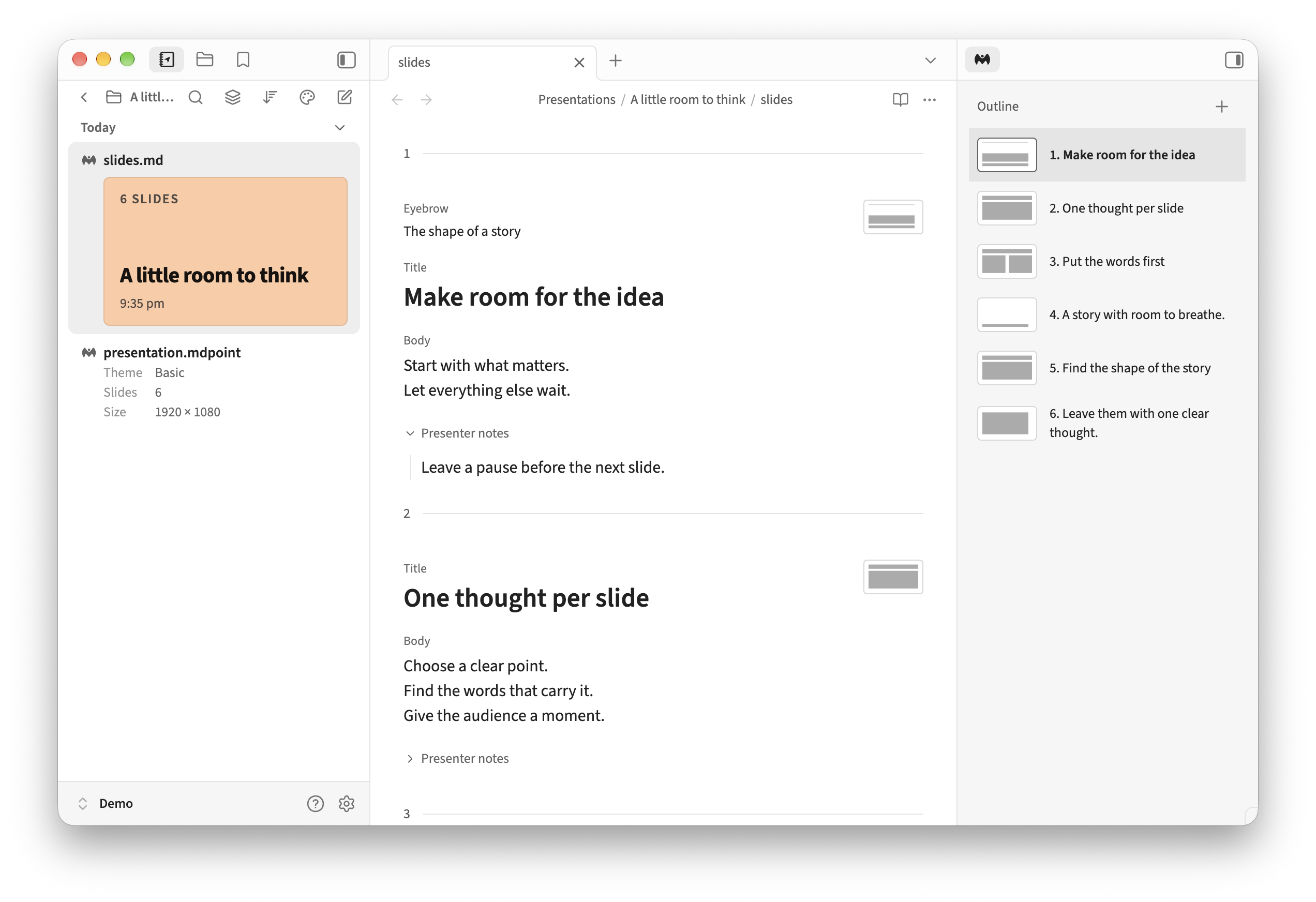
MarkdownPoint and its companion plugin for Obsidian are the best combination for modern presentations. Build the structure and write every word in Obsidian, then switch to the [MarkdownPoint](https://markdownpoint.com) desktop app for design, 3D, animation, rendering and much more.
Your whole talk becomes **one continuous draft**: titles, text and presenter notes flow down the page like a note, with an outline of every slide beside it. Drag slides into a new order, add a slide in one keystroke, and copy slides between presentations. There’s nothing to import or export between the two: both apps edit the same files in your vault.
Continuous draft. Drag-and-drop outline. Presenter notes. Layout shortcuts. 21 languages.
## 1 Installation
1. **Install Obsidian 1.13 or newer** on your desktop from [obsidian.md](https://obsidian.md/).
2. **Turn on community plugins** under **Settings → Community plugins**.
3. **Install MarkdownPoint**: select **Browse**, search for **MarkdownPoint**, then select **Install** and **Enable**.
4. **Get the desktop app** from [markdownpoint.com](https://markdownpoint.com) to design, present and export your slides.
## 2 Your first presentation
Open the command palette and run **MarkdownPoint: New presentation**. Enter a name, choose a folder, and pick **Basic** or a theme from another presentation in your vault. Select **Create**, and the presentation opens with one empty slide and the cursor ready in its first text area.
Already have a presentation? Put its whole folder in your vault and open `slides.md`:
```text
My presentation/
├── slides.md your writing, notes and slide order
├── presentation.mdpoint the presentation data
├── themes/
└── media/
```
Move and sync the folder as a whole, and both apps keep working on it.
## 3 Write the whole talk in one draft
Every slide starts with a numbered divider, followed by its text areas in writing order. Each area takes its name from the layout: Title, Body, Eyebrow or a name the theme gives it. An empty area shows its name as a faint placeholder. Start typing and the name moves up as a small label above your words. Placeholders and labels live only in the editor and are never saved.
Write in **Live Preview** to see the draft. It protects the slide dividers from stray edits, so you rearrange slides in the outline or from the right-click menu. Switch to **Source mode** whenever you want the plain Markdown, dividers included.
Blank lines only separate paragraphs, however many you leave, and the draft hides the ones between text areas. For an empty line on the slide, write `
` on a line of its own.
### Presenter notes
Click the **Presenter notes** row under a slide to open it, and write reminders, transitions or a full script. Notes travel with their slide when you move, copy or delete it, and each device remembers which notes you keep open.
### Images beside the draft
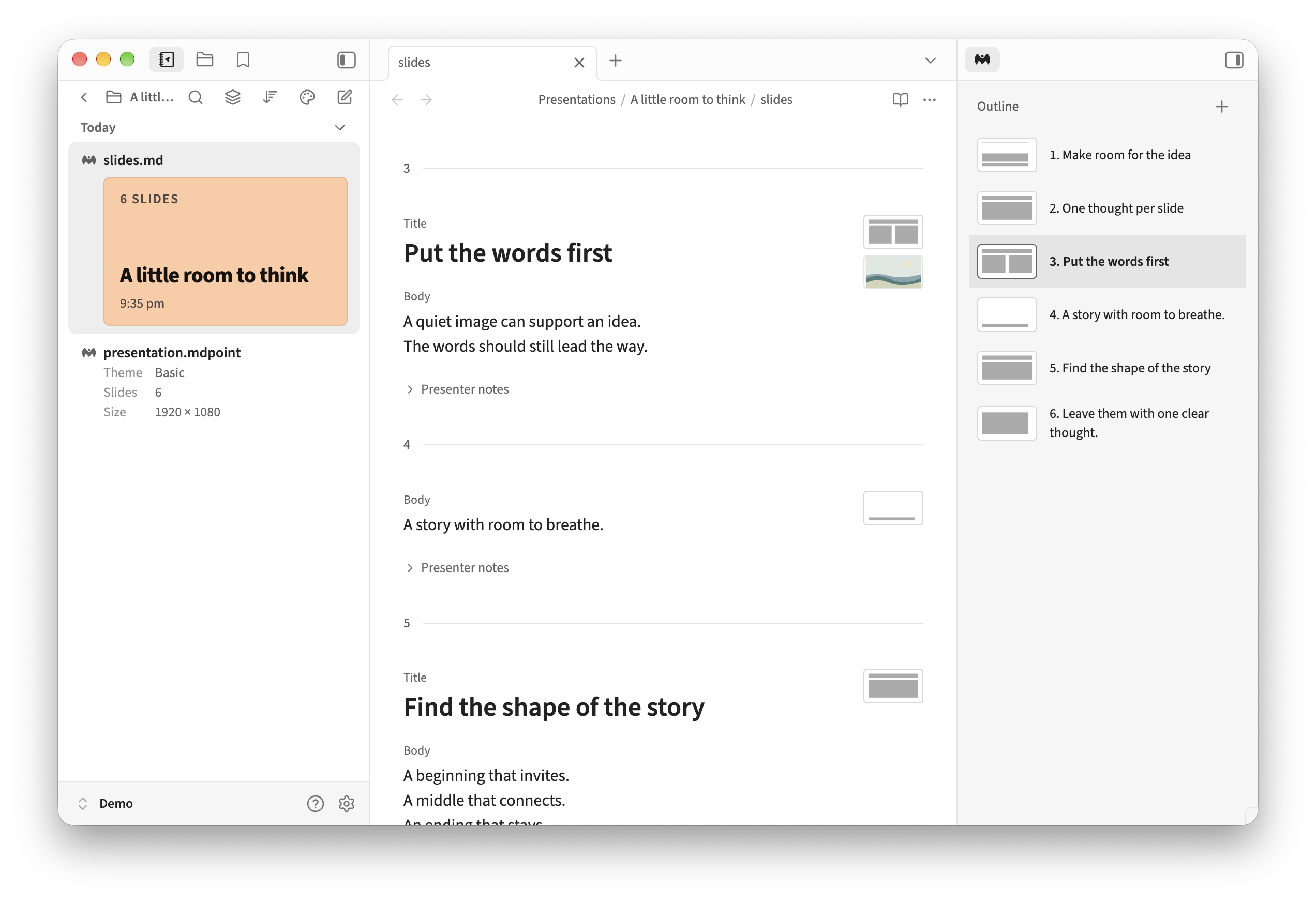
Up to five of a slide’s images appear under its thumbnail in the margin: the background first, then the layout’s image areas, then any other images on the slide. Add and change images in MarkdownPoint. To hide the previews, turn off **Settings → MarkdownPoint → Show images**.
## 4 Shape the story in the outline
The **Outline** has its own sidebar tab, marked with the MarkdownPoint icon, and opens in the right sidebar. Each row shows a slide’s title and a small map of its layout. Section headings divide the list without taking a slide number, and skipped slides show a dash instead of a number.
- **Click** a slide to select it and jump to it.
- **Cmd-click** on Mac or **Ctrl-click** on Windows and Linux to add or remove a slide.
- **Shift-click** to select a range, or **Shift+Up/Down** to extend it.
- **Cmd/Ctrl+A** selects every slide while the outline has focus.
**Drag** the selection anywhere in the list. A line shows where it lands, and dropping on a section heading puts the slides at the start of that section. Prefer the keyboard? While the outline has focus, **Cmd+Up/Down** on Mac or **Ctrl+Up/Down** on Windows and Linux moves the selection one row at a time.
### Copy, cut and delete slides
Right-click a slide in the outline or the editor for **Cut slide**, **Copy slide**, **Paste slides** and **Delete slide**. A slide’s thumbnail in the editor margin opens the same menu. In the outline, the menu acts on every selected slide, and **Cmd/Ctrl+C**, **X** and **V** copy, cut and paste whole slides. In the editor they stay ordinary text shortcuts. Pasted slides land below the slide whose menu you opened.
A copied slide brings its text, notes and presentation data with it. Paste it into another presentation in the same vault that uses the same theme, and its media comes along too. Between different themes or vaults, copy and paste the slides in the MarkdownPoint desktop app.
Obsidian’s **Undo** and **Redo** cover slide actions too, also while the outline has focus.
## 5 Add a slide in one keystroke
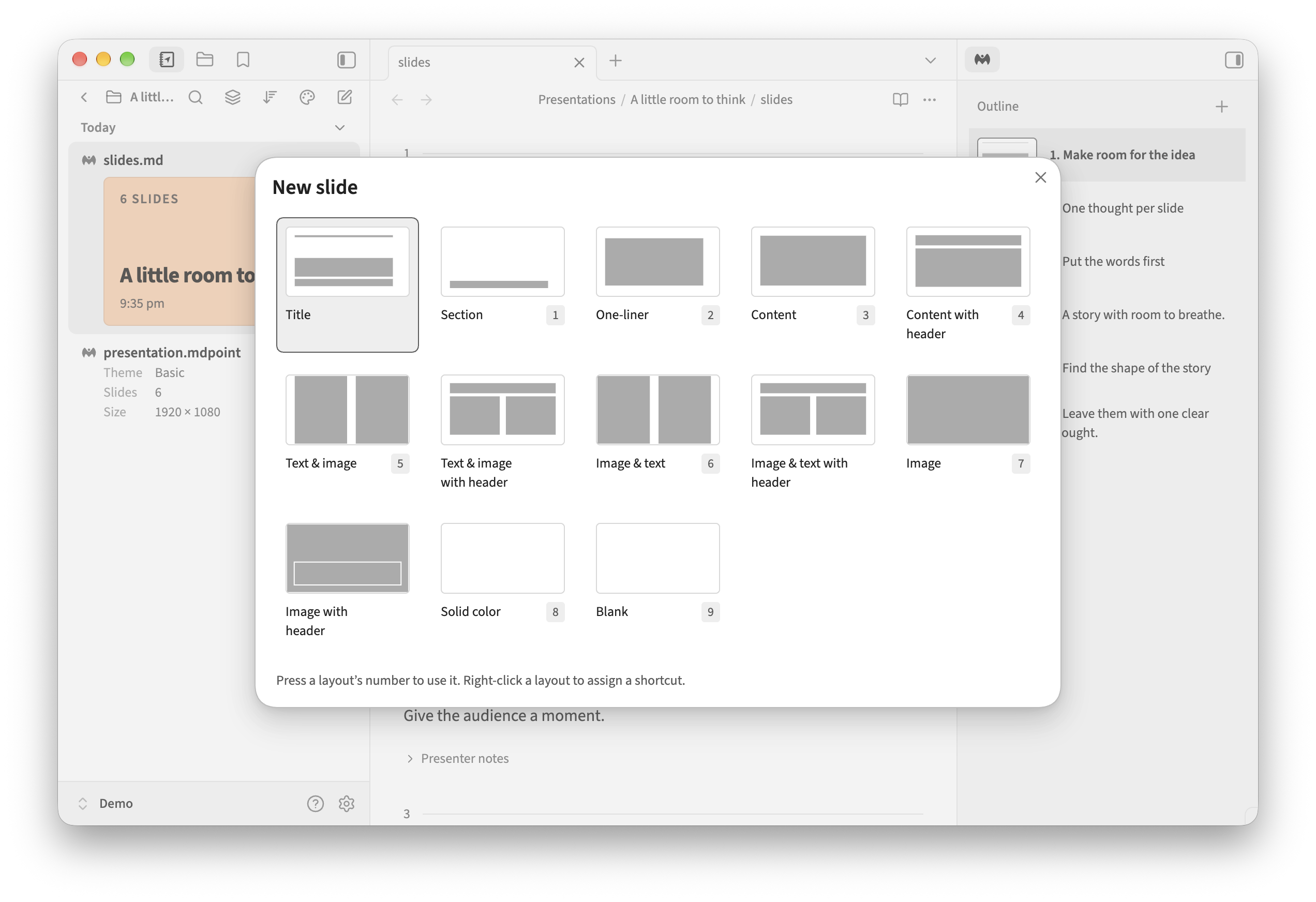
Click **+** above the outline or run **MarkdownPoint: New slide**, then choose a layout. The new slide goes below the current one.
Give your favorite layouts a number: right-click a layout in the picker and choose **Shortcut**, then a number from 1 to 9. Next time, open the picker and press that number. The number shows next to the layout’s name, and giving it to another layout moves it there. **None** removes it.
## 6 Design and present in MarkdownPoint
Run **MarkdownPoint: Open in MarkdownPoint** to save the presentation and open it in the desktop app. That’s where layout, images, 3D, animation and presenting happen. Come back to `slides.md` for another writing pass whenever you like, since both apps work on the same folder.
For the command to reach the app, your computer has to open `.mdpoint` files with MarkdownPoint.
## 7 Settings and hotkeys
**Settings → MarkdownPoint → Sidebar** puts the outline on the left or right. If you use Notebook Navigator, keep the outline on the right. Obsidian’s own controls show and hide the sidebar.
The plugin sets no hotkeys, so assign your own under **Settings → Hotkeys**:
| Command | What it does |
| --------------------- | -------------------------------------------------- |
| New presentation | Create a presentation in the vault. |
| New slide | Open the layout picker. |
| Focus outline | Reveal and focus the slide outline. |
| Focus editor | Return to the writing area. |
| Move slides up | Move the outline selection up. |
| Move slides down | Move the outline selection down. |
| Open in MarkdownPoint | Save and open the presentation in the desktop app. |
The move commands work while the outline has focus.
After an update, MarkdownPoint shows its release notes once. Turn this off with **Show release notes after updating**, or read them any time with **View recent updates**. The banner at the top of the settings links to the MarkdownPoint desktop app.
Sidebar placement and open notes are stored on each device. Layout shortcuts, **Show images** and **Show release notes after updating** are plugin settings, and they sync when your vault syncs plugin settings.
## 8 Languages
MarkdownPoint follows **Settings → General → Language** in 21 languages, with a right-to-left layout for Arabic and Persian:
English · العربية · Deutsch · Español · فارسی · Français · Bahasa Indonesia · Italiano · 日本語 · 한국어 · Nederlands · Polski · Português · Português do Brasil · Русский · ไทย · Türkçe · Українська · Tiếng Việt · 简体中文 · 繁體中文
Any other language shows the plugin in English. The words in your presentation never change with the language setting.
## 9 Questions
**Can I use Obsidian links and embeds?** They stay in the Markdown as you wrote them, but wikilinks, note embeds and other plugins’ output don’t become slide content. Use standard Markdown links for links that work outside Obsidian, and add slide images in MarkdownPoint.
**My presentation looks like an ordinary note.** Open `slides.md` in **Live Preview** and check that its `presentation.mdpoint` sits in the same folder. An unrelated note named `slides.md` stays an ordinary note, and an extra `.mdpoint` file or a conflicted copy in the folder makes the plugin leave both files alone. If a notice says the presentation uses a newer MarkdownPoint format, update the plugin in **Settings → Community plugins**.
**Can I write in a presentation saved by a newer MarkdownPoint?** Yes, as long as its format is 1.x. What the plugin doesn’t know stays in both files as MarkdownPoint wrote it, through writing, slide actions and undo. The files keep their version. Copying and cutting slides out of it needs a plugin update, so that a pasted slide brings nothing the other presentation's version lacks.
**The outline shows another presentation.** The outline keeps the last presentation you worked in, even while an ordinary note is open. Select the tab of the presentation you want.
**Some images are missing.** Keep the whole presentation folder together, media included. The editor shows up to five images per slide, and only files it can find.
**A slide action asks me to try again.** The presentation changed before the action finished. Wait for the latest changes to appear, then try again.
**Couldn’t save the presentation data.** Keep the vault open, fix the file or storage problem, then select **Retry** in the notice. Until then, a recovery copy is kept on this device.
Questions, or a problem you can reproduce? [Open an issue](https://github.com/markdownpoint/markdownpoint-obsidian/issues).