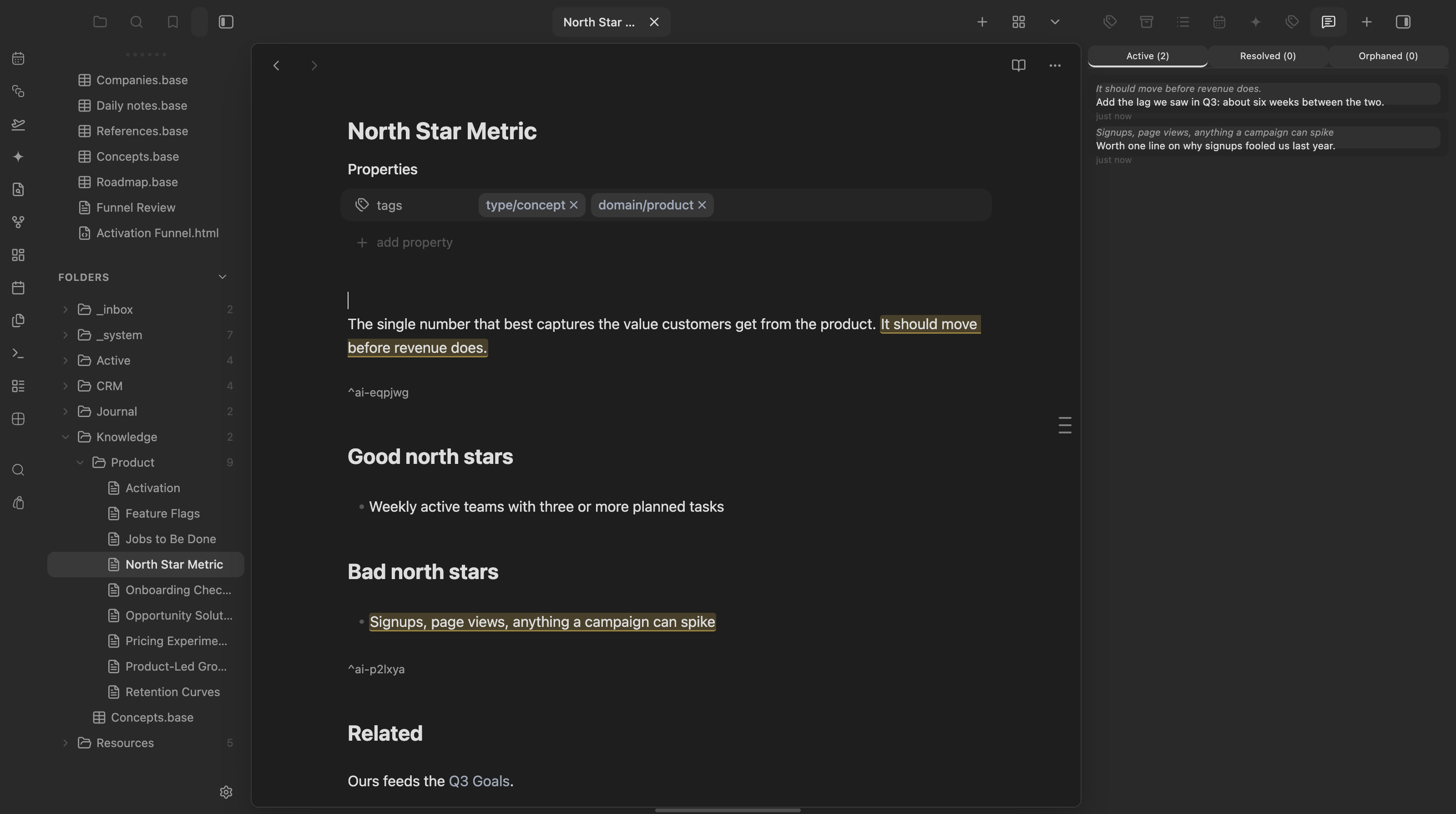
Two annotated blocks, highlighted inline with their block anchors, and the annotations panel on the right.
## Anchoring model Each annotated block gets an Obsidian block reference, `^ai-<6-char-id>`, inserted on a **standalone line** immediately after the block — never inline (inline `^id` breaks `hr`/table rendering). That block-id is the durable anchor: it lives inside the note file itself, so it survives edits and syncs across devices with zero external state. As cheap insurance, AIditor **also** stores a text-quote fallback (`quote` + up to 32 chars of `prefix`/`suffix` context, W3C-annotation style). If the `^ai-id` line is ever deleted, the annotation becomes `orphaned` instead of lost — the stored quote lets you re-anchor it to fresh text. AIditor never touches frontmatter and never uses Obsidian's YAML-rewriting helper (`processFrontMatter`) — that helper is known to mangle wikilinks in properties, so the block-id marker only ever lands as a plain line in the note body. ## Storage All annotations live in a single central sidecar file: ``` _system/annotations/store.json ``` Rationale: this keeps note frontmatter/body clean (only the tiny `^ai-id` marker lands in the note itself), it's Obsidian-Sync-friendly, and it avoids per-note-rename fragility — annotations are keyed by their own id + block-id, so a note is still re-locatable by searching for its block-id vault-wide even if `notePath` goes stale. Single-user, so last-write-wins is an acceptable model; writes are debounced and read-modify-write the whole file. ## Lifecycle Every annotation has a `status`: | Status | Meaning | |---|---| | `active` | Shown as a gutter marker in Live Preview + in the panel's Active filter. | | `resolved` | Hidden from the gutter; visible under the panel's Resolved filter; **reopenable**. | | `orphaned` | Its anchor block/`^ai-id` no longer exists in the note; hidden from the gutter; shown under the panel's Orphaned filter with the stored quote so it can be **re-anchored** (select new text, rebind) **or deleted**. | **Resolving archives — it does not delete.** Deletion is only ever explicit, triggered by the Delete action in the popover. Nothing is ever deleted automatically. ## Reading view: Live-Preview-only in the MVP AIditor's gutter markers and the "+" hover affordance work in **Live Preview only**. `src/reading.ts` registers a `MarkdownPostProcessor` for Reading view, but it is an **intentional no-op stub** for this release — it does not render markers on rendered Reading-view elements. This is a documented, scoped decision, not a silent gap: reliably matching Obsidian's rendered DOM elements back to block-id'd blocks (across paragraphs, lists, callouts, tables) is fiddly enough that it's better shipped as a deliberate fast-follow than rushed into MVP. See the `TODO` block at the top of `src/reading.ts` for the concrete plan when it's picked up. ## AI extension point AIditor exposes a public method directly on the plugin instance, mirroring the cross-plugin pattern used by Exo's `askExo`: ```ts app.plugins.plugins.aiditor.addAnnotation({ notePath: "Active/Projects/foo.md", quote: "the exact text to annotate", body: "the annotation text", }); // → Promise