# Finance Ledger
> 🇬🇧 English · [🇩🇪 Deutsch](https://github.com/johannes-kaindl/finance-ledger/blob/main/README.de.md)
An Obsidian plugin that renders hledger journals as filterable tables with balance and
category dashboards, transaction triage and categorizer-rule management — fed by a
companion Python importer.
[](https://github.com/johannes-kaindl/finance-ledger/blob/main/LICENSE)
[](https://github.com/johannes-kaindl/finance-ledger/blob/main/LICENSE-DOCS)
[](https://github.com/johannes-kaindl/finance-ledger/releases)

 > Plugin ID: `finance-ledger` (until 2026-06-10: `finance`).
## Status
**As of 2026-08-17 — importer port, stages E0–E3:** the built-in import now writes
`journal.ledger`, `accounts.ledger`, `opening_balances.ledger` **and** the account and
contract notes — without Python. It only touches what it produced itself: `anfangssaldo_eur`,
`created`, foreign frontmatter fields and everything below the `AUTO-GENERATED` marker
survive every run. Verified by `npm run smoke:gui` against a running Obsidian (21/21;
control run with the patch path removed: 15/20). Reports and dimension notes (E4–E7) still
come from the Python importer, run from a terminal.
**As of 2026-10-03 — the subprocess is gone entirely:** the import dialog, its
anti-duplicate preview and the re-import button no longer start the Python importer. The
plugin loads no Node module at all (`tests/bundle.test.ts` guards the built `main.js`), which
is what the Obsidian store review flags as *Shell Execution* and *Direct Filesystem Access*.
**Before that, as of 2026-08-04 — stages E0+E1:** CSV import runs **inside the plugin
itself** (TypeScript, no Python subprocess). Verified byte-for-byte against the Python
importer on real data: `journal.ledger` identical (1,576 transactions, 12 CSVs).
Reproducible with `npm run parity`.
**As of 2026-06-10 (post phase 1 of the publication track):** slices 1–10 plus the F15
design system merged. Mobile readiness (`Platform.isMobile` guards) and the design system
(KSP palette + finance tokens + light mode) integrated.
**Slice-10 detail-pages layer:** the importer writes 7 additional wikilink axes, 2 new note
classes (transaction types + mandates) and a life-area layer into the vault. Plugin code
unchanged (tolerant of extended note schemas).
**Tests:** 684 green. **Bundle size:** ~165 kB (`main.js`).
## Features
### Views
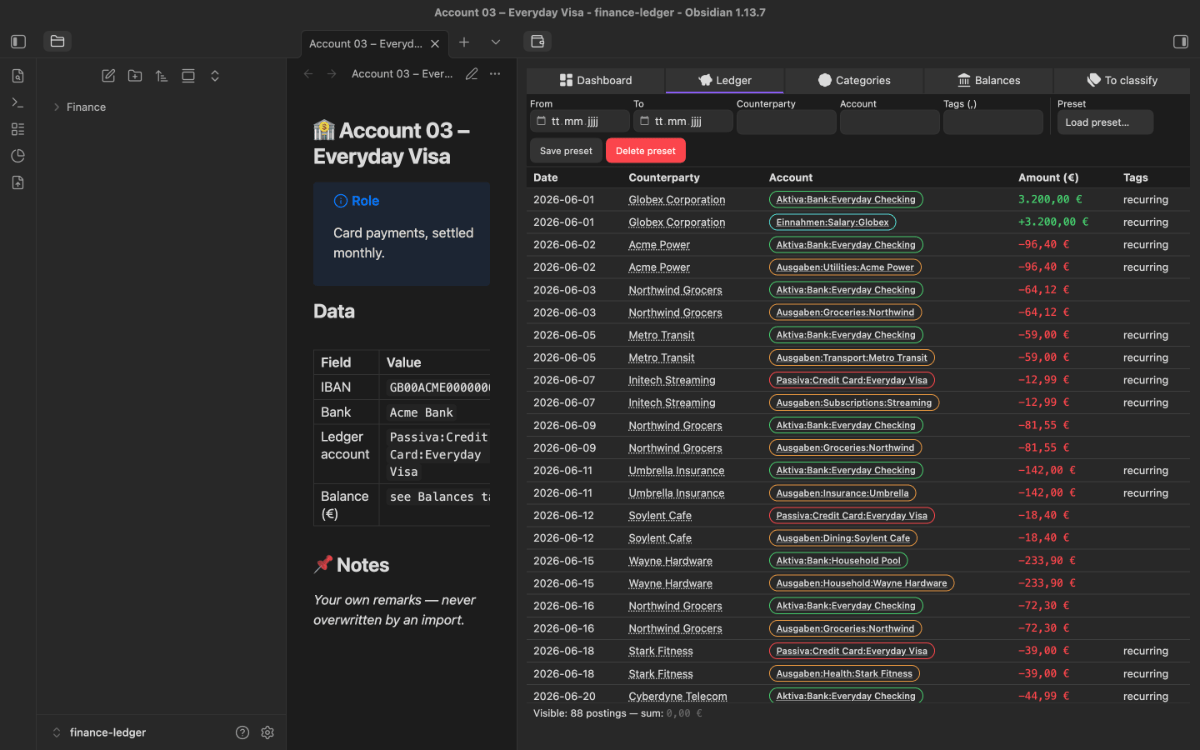
- **Ledger viewer** — sortable and filterable table of every transaction in `journal.ledger`,
with click-through navigation to category, account and payee notes
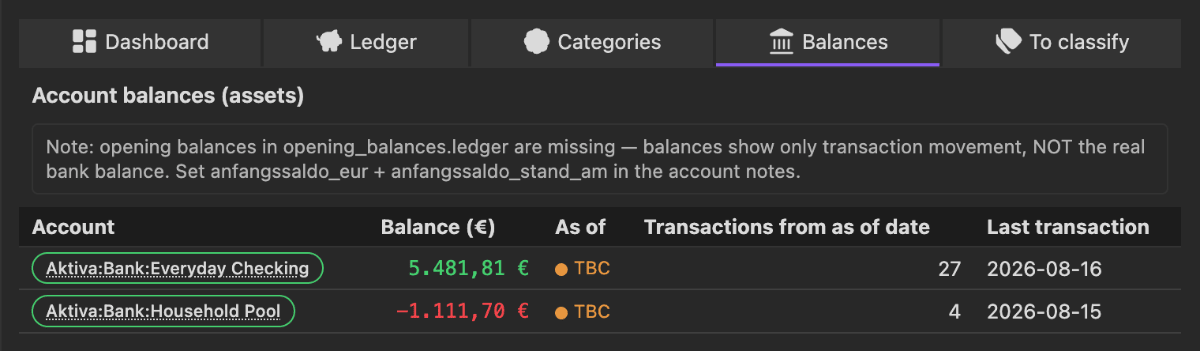
- **Balance overview** — **as-of-aware**: shows `opening balance (as-of date per account) +
transactions after that date`. Transactions before the as-of date are filtered out, so the
bootstrap workflow never double-counts. Accounts without `anfangssaldo_eur:` get a TBC marker.
- **Category overview** — hierarchical aggregate of all categories with percentage share
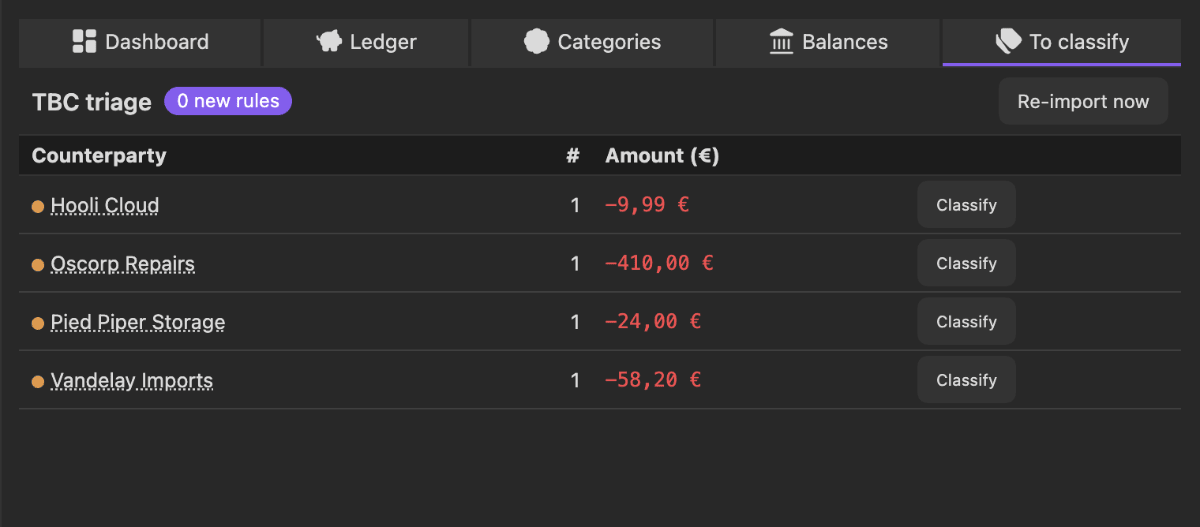
- **TBC triage** — every `:tbc:` transaction with a one-click action: *assign account, save
categorizer rule, remove tag*
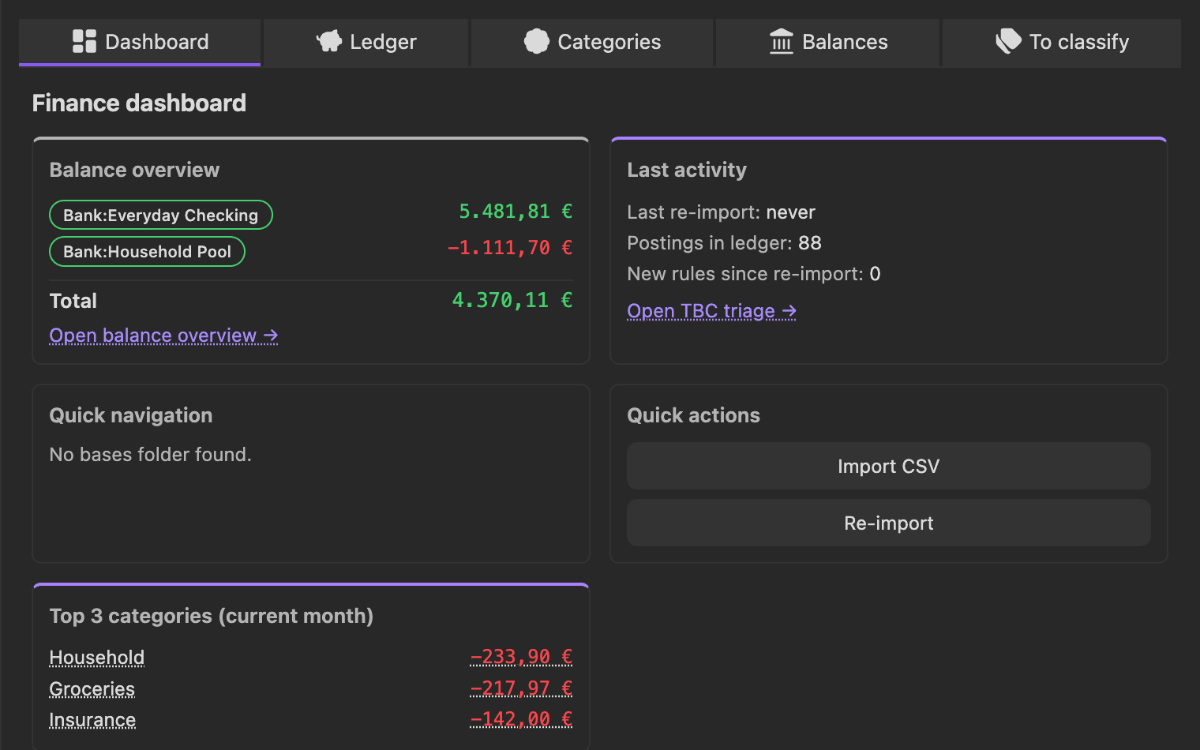
- **Finance dashboard** — five-card overview (balances, TBC backlog, recurring items, top
spending categories, upcoming contract payments)
### Actions
- **Rebuild journal from CSVs (built-in)** — a command that produces `journal.ledger` and
`accounts.ledger` inside the plugin: no Python, no `uv`, no subprocess. Works on mobile too.
Account configuration comes from a `konten.yaml` in the vault (setting: *accounts file*).
- **CSV import modal** — add several CSVs, see an anti-duplicate preview per file, then run
the import. All of it inside the plugin: no Python, no subprocess, no temporary files
outside the vault — so it works on mobile too.
- **Re-import** — re-runs the built-in import with a UI lock and counter reset
- **Snapshot before writing rules** — a dated copy of the rule folder, kept under
grandfather-father-son rotation (the 6 newest of today, plus the oldest of each of the
last 7 days, 4 weeks and 6 months)
- **Categorizer rule modal** — define a new pattern rule with a live match counter and
conflict check; writes to `categorizer-rules/`
- **Account suggestions** — type-ahead built from `accounts.ledger` plus a frontmatter crawl,
deduplicated
- **Deep-link URI** — `obsidian://finance?mode=ledger&filter=…` to drive the filters from outside
### What it looks like
> Plugin ID: `finance-ledger` (until 2026-06-10: `finance`).
## Status
**As of 2026-08-17 — importer port, stages E0–E3:** the built-in import now writes
`journal.ledger`, `accounts.ledger`, `opening_balances.ledger` **and** the account and
contract notes — without Python. It only touches what it produced itself: `anfangssaldo_eur`,
`created`, foreign frontmatter fields and everything below the `AUTO-GENERATED` marker
survive every run. Verified by `npm run smoke:gui` against a running Obsidian (21/21;
control run with the patch path removed: 15/20). Reports and dimension notes (E4–E7) still
come from the Python importer, run from a terminal.
**As of 2026-10-03 — the subprocess is gone entirely:** the import dialog, its
anti-duplicate preview and the re-import button no longer start the Python importer. The
plugin loads no Node module at all (`tests/bundle.test.ts` guards the built `main.js`), which
is what the Obsidian store review flags as *Shell Execution* and *Direct Filesystem Access*.
**Before that, as of 2026-08-04 — stages E0+E1:** CSV import runs **inside the plugin
itself** (TypeScript, no Python subprocess). Verified byte-for-byte against the Python
importer on real data: `journal.ledger` identical (1,576 transactions, 12 CSVs).
Reproducible with `npm run parity`.
**As of 2026-06-10 (post phase 1 of the publication track):** slices 1–10 plus the F15
design system merged. Mobile readiness (`Platform.isMobile` guards) and the design system
(KSP palette + finance tokens + light mode) integrated.
**Slice-10 detail-pages layer:** the importer writes 7 additional wikilink axes, 2 new note
classes (transaction types + mandates) and a life-area layer into the vault. Plugin code
unchanged (tolerant of extended note schemas).
**Tests:** 684 green. **Bundle size:** ~165 kB (`main.js`).
## Features
### Views
- **Ledger viewer** — sortable and filterable table of every transaction in `journal.ledger`,
with click-through navigation to category, account and payee notes
- **Balance overview** — **as-of-aware**: shows `opening balance (as-of date per account) +
transactions after that date`. Transactions before the as-of date are filtered out, so the
bootstrap workflow never double-counts. Accounts without `anfangssaldo_eur:` get a TBC marker.
- **Category overview** — hierarchical aggregate of all categories with percentage share
- **TBC triage** — every `:tbc:` transaction with a one-click action: *assign account, save
categorizer rule, remove tag*
- **Finance dashboard** — five-card overview (balances, TBC backlog, recurring items, top
spending categories, upcoming contract payments)
### Actions
- **Rebuild journal from CSVs (built-in)** — a command that produces `journal.ledger` and
`accounts.ledger` inside the plugin: no Python, no `uv`, no subprocess. Works on mobile too.
Account configuration comes from a `konten.yaml` in the vault (setting: *accounts file*).
- **CSV import modal** — add several CSVs, see an anti-duplicate preview per file, then run
the import. All of it inside the plugin: no Python, no subprocess, no temporary files
outside the vault — so it works on mobile too.
- **Re-import** — re-runs the built-in import with a UI lock and counter reset
- **Snapshot before writing rules** — a dated copy of the rule folder, kept under
grandfather-father-son rotation (the 6 newest of today, plus the oldest of each of the
last 7 days, 4 weeks and 6 months)
- **Categorizer rule modal** — define a new pattern rule with a live match counter and
conflict check; writes to `categorizer-rules/`
- **Account suggestions** — type-ahead built from `accounts.ledger` plus a frontmatter crawl,
deduplicated
- **Deep-link URI** — `obsidian://finance?mode=ledger&filter=…` to drive the filters from outside
### What it looks like

 ## How it works
The plugin **does not compute from raw data** — it reads the hledger journal the importer
wrote and turns it into views. The one place where it does compute is the account balance:
### As-of-aware balance logic
The plugin parses `opening_balances.ledger` with a small dedicated parser
(`src/aggregator/openingBalances.ts`):
```typescript
parseOpeningBalances(text: string): Map
```
`computeSaldo(account)` = `opening.amount + Sum(tx where tx.date > opening.standAm)`.
Bootstrap workflow: you put the current bank balance and today's date into the account
note's frontmatter (`anfangssaldo_eur` + `anfangssaldo_stand_am`). The importer turns that
into `opening_balances.ledger`. The plugin then filters out transactions before the as-of date.
## Requirements
- **Obsidian 1.8.7 or newer**, desktop and mobile (`isDesktopOnly: false`).
- An **hledger journal in the vault** — `journal.ledger`, `accounts.ledger` and optionally
`opening_balances.ledger`. Without a journal the views show nothing.
- For the **built-in** journal rebuild from CSVs: a `konten.yaml` in the vault. No Python,
no `uv` — this path works on mobile as well.
- Only for the **re-import through the companion repository** (reports and note generators):
desktop, `uv`, and a checkout of the Python importer.
## Install
**Recommended — from the community store:** Obsidian → Settings → Community plugins → Browse → search for **Finance Ledger** → Install → Enable. Updates arrive through Obsidian like for any other plugin.
**Alternatively — via [AnySource Sideloader](https://git.jkaindl.de/jkaindl/anysource-sideloader)**, which installs and updates plugins from any git forge. Subscribe to this catalog once:
```
https://git.jkaindl.de/jkaindl/obsidian-catalog/raw/branch/main/catalog.json
```
Finance Ledger then appears in the sideloader's plugin list and updates like any other plugin — no manual copying, and every download is checksum-verified.
**By hand**, if you would rather not use either:
1. Download `main.js`, `manifest.json` and `styles.css` from the
[latest release](https://github.com/johannes-kaindl/finance-ledger/releases).
2. Copy them into `/.obsidian/plugins/finance-ledger/`.
3. Obsidian → Settings → Community plugins → enable **Finance Ledger**.
Updates then have to be repeated by hand — the store and the sideloader exist to avoid exactly that.
From source: `npm install && npm run build` produces the same files; `npm run deploy` puts
them straight into a configured vault (see *Build and deploy*).
## Usage
The pie-chart icon in the ribbon opens the dashboard. Everything else lives in the command
palette:
| Command | View |
|---|---|
| `Open finance dashboard` | five-card overview: balances, TBC backlog, recurring items, top spending, upcoming contracts |
| `Open ledger viewer` | the filterable transaction table |
| `Open balance overview` | balance per account, corrected for the as-of date |
| `Open category overview` | hierarchical category aggregate |
| `Open TBC triage` | the open `:tbc:` transactions with one-click assignment |
| `Rebuild journal from CSVs (built-in)` | rebuilds `journal.ledger` and `accounts.ledger` — no external process |
| `Finance: import CSV` | multi-file upload with deduplication (desktop only) |
The usual loop: rebuild or import the journal → work through **TBC triage** (each assignment
also writes a categorizer rule, so the same transaction lands by itself next time) → read
the dashboard.
From outside, the plugin can be driven through
`obsidian://finance?mode=ledger&filter=…`.
## Configuration
Settings → Community plugins → **Finance Ledger**:
## How it works
The plugin **does not compute from raw data** — it reads the hledger journal the importer
wrote and turns it into views. The one place where it does compute is the account balance:
### As-of-aware balance logic
The plugin parses `opening_balances.ledger` with a small dedicated parser
(`src/aggregator/openingBalances.ts`):
```typescript
parseOpeningBalances(text: string): Map
```
`computeSaldo(account)` = `opening.amount + Sum(tx where tx.date > opening.standAm)`.
Bootstrap workflow: you put the current bank balance and today's date into the account
note's frontmatter (`anfangssaldo_eur` + `anfangssaldo_stand_am`). The importer turns that
into `opening_balances.ledger`. The plugin then filters out transactions before the as-of date.
## Requirements
- **Obsidian 1.8.7 or newer**, desktop and mobile (`isDesktopOnly: false`).
- An **hledger journal in the vault** — `journal.ledger`, `accounts.ledger` and optionally
`opening_balances.ledger`. Without a journal the views show nothing.
- For the **built-in** journal rebuild from CSVs: a `konten.yaml` in the vault. No Python,
no `uv` — this path works on mobile as well.
- Only for the **re-import through the companion repository** (reports and note generators):
desktop, `uv`, and a checkout of the Python importer.
## Install
**Recommended — from the community store:** Obsidian → Settings → Community plugins → Browse → search for **Finance Ledger** → Install → Enable. Updates arrive through Obsidian like for any other plugin.
**Alternatively — via [AnySource Sideloader](https://git.jkaindl.de/jkaindl/anysource-sideloader)**, which installs and updates plugins from any git forge. Subscribe to this catalog once:
```
https://git.jkaindl.de/jkaindl/obsidian-catalog/raw/branch/main/catalog.json
```
Finance Ledger then appears in the sideloader's plugin list and updates like any other plugin — no manual copying, and every download is checksum-verified.
**By hand**, if you would rather not use either:
1. Download `main.js`, `manifest.json` and `styles.css` from the
[latest release](https://github.com/johannes-kaindl/finance-ledger/releases).
2. Copy them into `/.obsidian/plugins/finance-ledger/`.
3. Obsidian → Settings → Community plugins → enable **Finance Ledger**.
Updates then have to be repeated by hand — the store and the sideloader exist to avoid exactly that.
From source: `npm install && npm run build` produces the same files; `npm run deploy` puts
them straight into a configured vault (see *Build and deploy*).
## Usage
The pie-chart icon in the ribbon opens the dashboard. Everything else lives in the command
palette:
| Command | View |
|---|---|
| `Open finance dashboard` | five-card overview: balances, TBC backlog, recurring items, top spending, upcoming contracts |
| `Open ledger viewer` | the filterable transaction table |
| `Open balance overview` | balance per account, corrected for the as-of date |
| `Open category overview` | hierarchical category aggregate |
| `Open TBC triage` | the open `:tbc:` transactions with one-click assignment |
| `Rebuild journal from CSVs (built-in)` | rebuilds `journal.ledger` and `accounts.ledger` — no external process |
| `Finance: import CSV` | multi-file upload with deduplication (desktop only) |
The usual loop: rebuild or import the journal → work through **TBC triage** (each assignment
also writes a categorizer rule, so the same transaction lands by itself next time) → read
the dashboard.
From outside, the plugin can be driven through
`obsidian://finance?mode=ledger&filter=…`.
## Configuration
Settings → Community plugins → **Finance Ledger**:
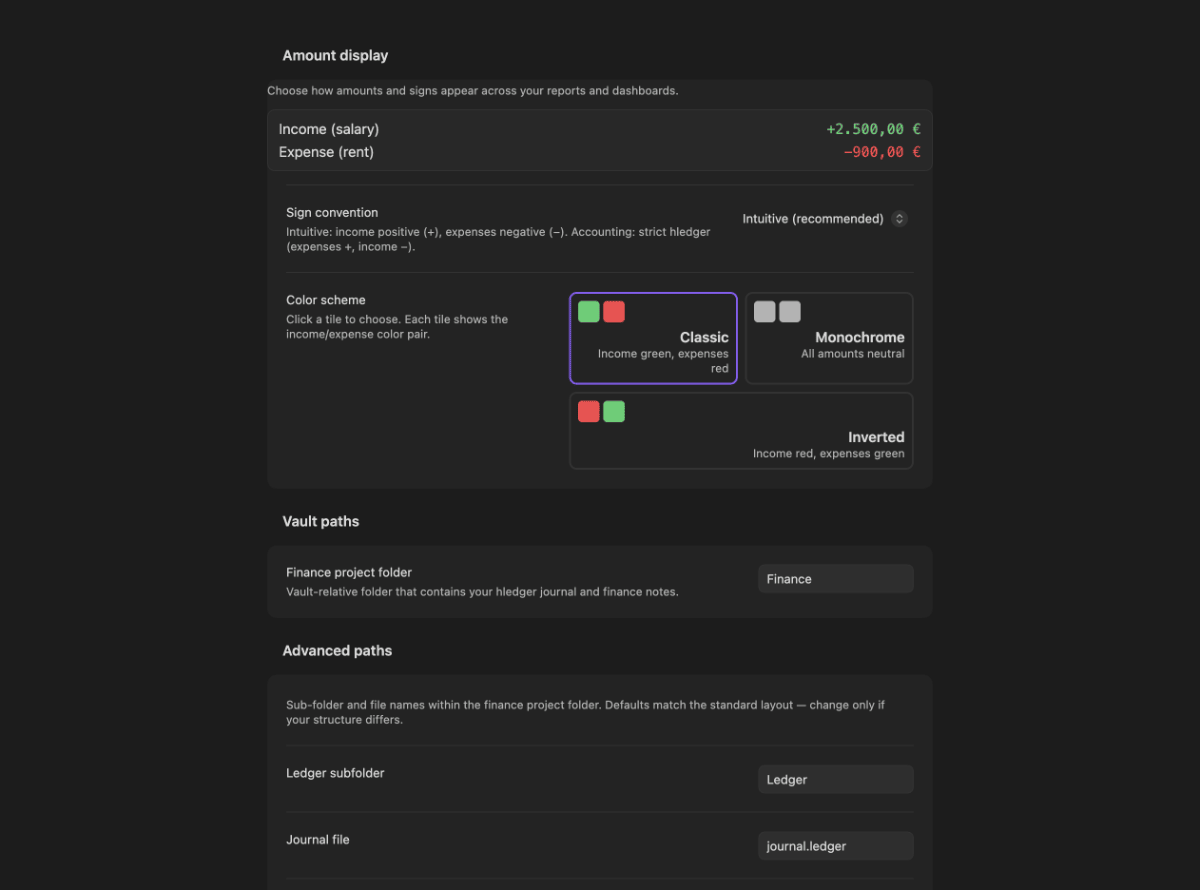 - **Amount display**: sign mode (*intuitive*: income +, expenses − · *accounting*: raw, as in
hledger) plus a colour scheme (classic / monochrome / inverted) shown as swatch tiles with a
live preview. Cash flow follows the setting, balances stay sign-based; colour follows the
account type and is orthogonal to the sign.
- Vault-relative paths to ledger, accounts, contracts and categorizer rules
- `uv` binary path, with auto-detect fallback
- Filter presets (create, edit, delete — stored locally)
## Documentation
The full documentation lives in [`docs/`](https://github.com/johannes-kaindl/finance-ledger/blob/main/docs/README.md):
- **[Getting started](https://github.com/johannes-kaindl/finance-ledger/blob/main/docs/getting-started.md)** — from the install to your first balance overview.
- **[Troubleshooting](https://github.com/johannes-kaindl/finance-ledger/blob/main/docs/troubleshooting.md)** — the exact message you see, what it means, what to do.
- **[Design system](https://github.com/johannes-kaindl/finance-ledger/blob/main/docs/design.md)** — tokens and where they are wired.
## Design system
The plugin uses three layers:
- **Obsidian CSS variables** for layout, typography, borders and surfaces (theme-agnostic)
- **`--fl-*` tokens** for finance-specific semantics (credit/debit/TBC colours, account-type
accents, money display, typed card top borders)
- the **KSP signal palette** as the foundation of the `--fl-*` tokens, with light-mode
corrections for AA contrast
Wired into five views — balance overview, finance dashboard, ledger view, TBC triage and
category overview. Money values carry `.fl-money` plus a sign colour, account chips a
`data-type` outline, cards a `data-card` top border, status dots `.fl-txn-state`. The
light-mode bridge dims the signal colours to keep AA contrast.
Detailed documentation: [`docs/design.md`](https://github.com/johannes-kaindl/finance-ledger/blob/main/docs/design.md) (high level plus wiring state)
and [`docs/design/README.md`](https://github.com/johannes-kaindl/finance-ledger/blob/main/docs/design/README.md) (canonical token files).
## Mobile status
- **No desktop-only paths left (as of 2026-10-03):** the CSV import modal, the preview and
the re-import all run inside the plugin. The Python subprocess and the Node filesystem
access are gone, so the platform guards that went with them are gone too.
⚠️ Not yet verified on a physical phone or tablet — the code path is free of Node APIs and
covered by tests, but the file picker on mobile has not been exercised.
- **Still desktop-bound:** reports and dimension notes (monthly/quarterly/yearly reports,
category, payee, transaction-type and mandate notes). Those come from the Python importer,
run from a terminal — the plugin offers the full command as a copy button.
- **Mobile icons:** on iPhone and iPad some placeholder icons are still visible after the
last icon fix — diagnosis is pending on a desktop with mobile dev tools.
## The companion importer
The Python CLI importer that produces the journal is a separate project and is **not
published yet**. Its output in the vault lives under `//Ledger/` plus
the note folders (German names, as the code expects them) `10-Konten`, `20-Verträge`,
`30-Sparziele`, `40-Monatsberichte`, `45-Kategorien`, `55-Categorizer-Rules`, `60-Empfänger`,
`70-Quartalsberichte`, `80-Jahresberichte` and `05-Bases`.
Everything the plugin needs beyond that journal — the built-in rebuild from CSVs — it does
on its own.
### Output note schema (marker system)
Every note the importer writes (account, report, category, payee, rule) uses a marker
pattern that protects user edits:
```
---
frontmatter
---
auto section (tables, mermaid charts, bases embeds, cross-references)
## 📌 Notes
user edit zone — untouched on re-runs.
```
On top of that: mermaid charts (pie for top categories, bar and xy-line for trends) and
collapsible bases embeds inside `[!quote]` callouts.
### Budget layer
Monthly reports carry a budget section: target (12-month average) / actual / forecast
(linear extrapolation) / difference / traffic light (🟢 below 90 % of target, 🟡 90–110 %,
🔴 above 110 %). A caveat warning appears when the average rests on fewer than 12 months.
## Build and deploy
```bash
npm install # once
npm test # vitest run (684 green)
npm run build # esbuild → main.js (repo root)
npm run dev # esbuild --watch (inline sourcemap, no minify)
npm run deploy # build + copy manifest.json, main.js, styles.css into a vault
```
`npm run deploy` copies into the target set through an environment variable:
```bash
export OBSIDIAN_PLUGIN_DIR="/.obsidian/plugins/finance-ledger"
npm run deploy
```
Then in Obsidian: Settings → Community plugins → turn off safe mode → enable **Finance
Ledger**. On updates, run `npm run deploy` again and reload the plugin (toggle it off and
on, or `Cmd+R`).
## Repository layout
| Path | Purpose |
|------|---------|
| `src/` | TypeScript sources (views, ui, parser, resolver, state, types, utils, aggregator, categorizer rules) |
| `src/aggregator/openingBalances.ts` | as-of-aware parser for `opening_balances.ledger` |
| `src/aggregator/saldo.ts` | as-of-aware `computeSaldo` |
| `tests/` | vitest specs (684 tests green) |
| `docs/design/` | canonical design-system source of truth |
| `docs/design.md` | high-level design-system explanation |
| `styles.css` | plugin styles with tokens and utilities |
| `manifest.json` | Obsidian plugin manifest (id: `finance-ledger`) |
| `main.js` | esbuild output (committed, as Obsidian plugins require) |
| `package.json` | npm scripts |
| `esbuild.config.mjs` | bundle config |
| `vitest.config.ts` | test config |
| `tsconfig.json` | TypeScript config |
| `AGENTS.md` | architecture conventions for coding agents |
| `CHANGELOG.md` | release notes |
## License
- **Code:** AGPL-3.0-or-later ([`LICENSE`](https://github.com/johannes-kaindl/finance-ledger/blob/main/LICENSE))
- **Documentation and prose:** CC BY-SA 4.0 ([`LICENSE-DOCS`](https://github.com/johannes-kaindl/finance-ledger/blob/main/LICENSE-DOCS))
Copyright © 2026 Johannes Kaindl.
- **Amount display**: sign mode (*intuitive*: income +, expenses − · *accounting*: raw, as in
hledger) plus a colour scheme (classic / monochrome / inverted) shown as swatch tiles with a
live preview. Cash flow follows the setting, balances stay sign-based; colour follows the
account type and is orthogonal to the sign.
- Vault-relative paths to ledger, accounts, contracts and categorizer rules
- `uv` binary path, with auto-detect fallback
- Filter presets (create, edit, delete — stored locally)
## Documentation
The full documentation lives in [`docs/`](https://github.com/johannes-kaindl/finance-ledger/blob/main/docs/README.md):
- **[Getting started](https://github.com/johannes-kaindl/finance-ledger/blob/main/docs/getting-started.md)** — from the install to your first balance overview.
- **[Troubleshooting](https://github.com/johannes-kaindl/finance-ledger/blob/main/docs/troubleshooting.md)** — the exact message you see, what it means, what to do.
- **[Design system](https://github.com/johannes-kaindl/finance-ledger/blob/main/docs/design.md)** — tokens and where they are wired.
## Design system
The plugin uses three layers:
- **Obsidian CSS variables** for layout, typography, borders and surfaces (theme-agnostic)
- **`--fl-*` tokens** for finance-specific semantics (credit/debit/TBC colours, account-type
accents, money display, typed card top borders)
- the **KSP signal palette** as the foundation of the `--fl-*` tokens, with light-mode
corrections for AA contrast
Wired into five views — balance overview, finance dashboard, ledger view, TBC triage and
category overview. Money values carry `.fl-money` plus a sign colour, account chips a
`data-type` outline, cards a `data-card` top border, status dots `.fl-txn-state`. The
light-mode bridge dims the signal colours to keep AA contrast.
Detailed documentation: [`docs/design.md`](https://github.com/johannes-kaindl/finance-ledger/blob/main/docs/design.md) (high level plus wiring state)
and [`docs/design/README.md`](https://github.com/johannes-kaindl/finance-ledger/blob/main/docs/design/README.md) (canonical token files).
## Mobile status
- **No desktop-only paths left (as of 2026-10-03):** the CSV import modal, the preview and
the re-import all run inside the plugin. The Python subprocess and the Node filesystem
access are gone, so the platform guards that went with them are gone too.
⚠️ Not yet verified on a physical phone or tablet — the code path is free of Node APIs and
covered by tests, but the file picker on mobile has not been exercised.
- **Still desktop-bound:** reports and dimension notes (monthly/quarterly/yearly reports,
category, payee, transaction-type and mandate notes). Those come from the Python importer,
run from a terminal — the plugin offers the full command as a copy button.
- **Mobile icons:** on iPhone and iPad some placeholder icons are still visible after the
last icon fix — diagnosis is pending on a desktop with mobile dev tools.
## The companion importer
The Python CLI importer that produces the journal is a separate project and is **not
published yet**. Its output in the vault lives under `//Ledger/` plus
the note folders (German names, as the code expects them) `10-Konten`, `20-Verträge`,
`30-Sparziele`, `40-Monatsberichte`, `45-Kategorien`, `55-Categorizer-Rules`, `60-Empfänger`,
`70-Quartalsberichte`, `80-Jahresberichte` and `05-Bases`.
Everything the plugin needs beyond that journal — the built-in rebuild from CSVs — it does
on its own.
### Output note schema (marker system)
Every note the importer writes (account, report, category, payee, rule) uses a marker
pattern that protects user edits:
```
---
frontmatter
---
auto section (tables, mermaid charts, bases embeds, cross-references)
## 📌 Notes
user edit zone — untouched on re-runs.
```
On top of that: mermaid charts (pie for top categories, bar and xy-line for trends) and
collapsible bases embeds inside `[!quote]` callouts.
### Budget layer
Monthly reports carry a budget section: target (12-month average) / actual / forecast
(linear extrapolation) / difference / traffic light (🟢 below 90 % of target, 🟡 90–110 %,
🔴 above 110 %). A caveat warning appears when the average rests on fewer than 12 months.
## Build and deploy
```bash
npm install # once
npm test # vitest run (684 green)
npm run build # esbuild → main.js (repo root)
npm run dev # esbuild --watch (inline sourcemap, no minify)
npm run deploy # build + copy manifest.json, main.js, styles.css into a vault
```
`npm run deploy` copies into the target set through an environment variable:
```bash
export OBSIDIAN_PLUGIN_DIR="/.obsidian/plugins/finance-ledger"
npm run deploy
```
Then in Obsidian: Settings → Community plugins → turn off safe mode → enable **Finance
Ledger**. On updates, run `npm run deploy` again and reload the plugin (toggle it off and
on, or `Cmd+R`).
## Repository layout
| Path | Purpose |
|------|---------|
| `src/` | TypeScript sources (views, ui, parser, resolver, state, types, utils, aggregator, categorizer rules) |
| `src/aggregator/openingBalances.ts` | as-of-aware parser for `opening_balances.ledger` |
| `src/aggregator/saldo.ts` | as-of-aware `computeSaldo` |
| `tests/` | vitest specs (684 tests green) |
| `docs/design/` | canonical design-system source of truth |
| `docs/design.md` | high-level design-system explanation |
| `styles.css` | plugin styles with tokens and utilities |
| `manifest.json` | Obsidian plugin manifest (id: `finance-ledger`) |
| `main.js` | esbuild output (committed, as Obsidian plugins require) |
| `package.json` | npm scripts |
| `esbuild.config.mjs` | bundle config |
| `vitest.config.ts` | test config |
| `tsconfig.json` | TypeScript config |
| `AGENTS.md` | architecture conventions for coding agents |
| `CHANGELOG.md` | release notes |
## License
- **Code:** AGPL-3.0-or-later ([`LICENSE`](https://github.com/johannes-kaindl/finance-ledger/blob/main/LICENSE))
- **Documentation and prose:** CC BY-SA 4.0 ([`LICENSE-DOCS`](https://github.com/johannes-kaindl/finance-ledger/blob/main/LICENSE-DOCS))
Copyright © 2026 Johannes Kaindl.