# AnySource Sideloader
[](https://github.com/johannes-kaindl/anysource-sideloader/blob/main/LICENSE)
[](https://github.com/johannes-kaindl/anysource-sideloader/releases/latest)

Install and update Obsidian plugins from any git forge — GitHub, Forgejo, Gitea, or raw
URLs — including subscribable plugin catalogs, without waiting on the Community Store.
*Auch auf Deutsch verfügbar: [`README.de.md`](https://github.com/johannes-kaindl/anysource-sideloader/blob/main/README.de.md).*
## Why this exists
Not every plugin you want to use is in the Community Store: your own plugins, an
organisation's internal plugins in a private repository, and plugins that live on a
self-hosted forge such as Forgejo or Gitea. AnySource Sideloader installs and updates these
straight from their release pages, and keeps them up to date the way the Store does for its own
plugins — with a visible check, release notes and a confirmation before anything is applied.
It is a complement to the Store, not a replacement: plugins you already have from the Store
are left alone unless you choose to track them.
It also removes a single point of failure. The Store depends on GitHub, and when a maintainer's
account is flagged, their plugins can become uninstallable overnight — one such flag made 21
plugins disappear in a single day, none of them with a code problem. A plugin whose release
also lives on another forge stays installable.
The full trade-off, including what a single self-hosted channel costs, is in
[Why there is only one distribution channel](https://github.com/johannes-kaindl/anysource-sideloader/blob/main/docs/explanation/why-one-channel.md).
## Features
- **Any git forge as a source** — GitHub, Forgejo, Gitea, or a plain raw-file URL. The forge
type is detected from a pasted repo URL; nothing needs to be configured per source.
- **Subscribable catalogs** — a catalog is one JSON file listing plugins. Versions always come
live from each plugin's own forge, never from the catalog.
- **Everything lives in the settings tab**, where Obsidian manages plugins anyway — no extra
sidebar view, and the layout is Obsidian's own.
- **Tracks plugins you already have.** Installed but unmanaged plugins are recognised and can
be adopted with one click, or all at once — no reinstall, no version loss.
- **Checksum verification** of every downloaded release asset before anything is written.
- **Private repositories** via per-host access tokens kept in Obsidian's keychain.
- **Nothing happens without confirmation** — every install and update is a deliberate, visible
action, and updates are never applied automatically.
## Requirements
- Obsidian **1.11.4** or newer (the version that introduced the keychain API used for access
tokens).
- Works on **desktop and mobile**; no Node, no runtime dependencies, no external binaries.
- A network connection to whichever forge hosts the plugins you install. Nothing is sent
anywhere else.
## Install
Because this plugin's whole purpose is working without the Community Store, its own first
install is manual. It is the only one — from then on the plugin installs and updates
everything else, including itself.
The steps are the same on **macOS, Linux and Windows**. You do not need to find your vault on
disk and you do not need to unhide hidden folders.
1. **Allow community plugins.** Settings → Community plugins; if it offers **Exit Restricted
mode**, click that first. A plugin sitting in exactly the right place never loads while
Restricted mode is on, with no error to tell you so.
2. **Download the three files** from the [latest GitHub release](https://github.com/johannes-kaindl/anysource-sideloader/releases/latest): [`main.js`](https://github.com/johannes-kaindl/anysource-sideloader/releases/latest/download/main.js), [`manifest.json`](https://github.com/johannes-kaindl/anysource-sideloader/releases/latest/download/manifest.json) and [`styles.css`](https://github.com/johannes-kaindl/anysource-sideloader/releases/latest/download/styles.css). Those links always point at the newest release.
3. **Open the plugins folder from inside Obsidian** — still under Community plugins, click the folder icon next to *Installed plugins* (*Open plugins folder*). Your file manager opens in `/.obsidian/plugins/`.
4. **Create a folder named `anysource-sideloader` there** and put the three files directly into it.
5. **Click *Reload plugins*** and switch **AnySource Sideloader** on. No restart needed.
Longer version with the folder layout and what to do if something does not load:
[Install by hand](https://github.com/johannes-kaindl/anysource-sideloader/blob/main/docs/how-to/manual-install.md).
## Usage
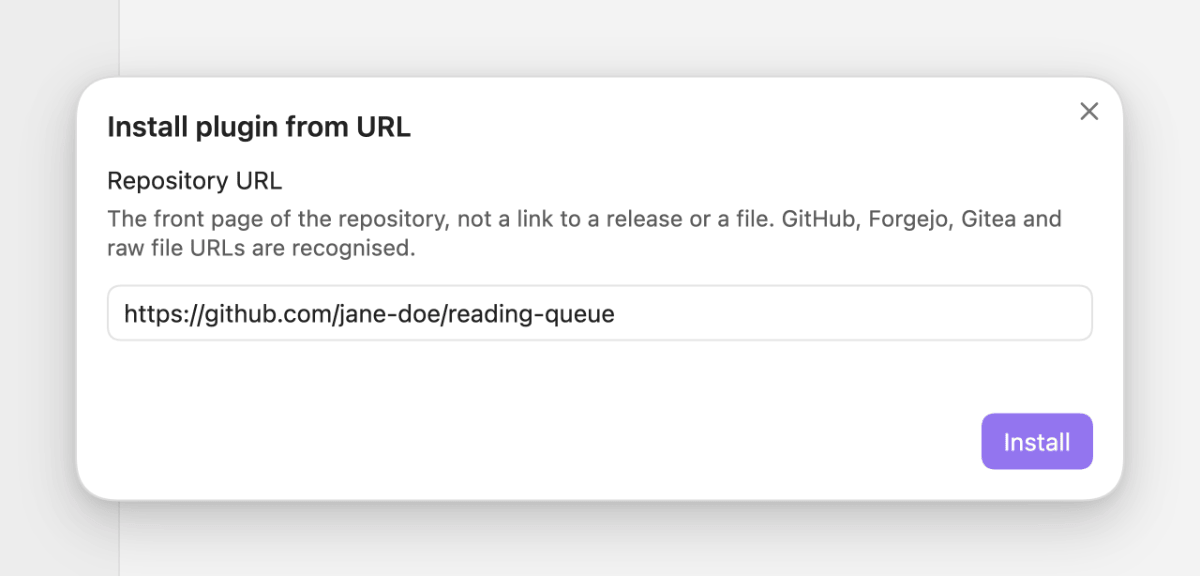
**Add a plugin.** Run the command **Install plugin from URL** and paste a repository URL — the front page of the repo, not a release or file link:
```
https://github.com/user/repo
https://git.jkaindl.de/jkaindl/some-plugin
```
The forge type is detected automatically. → [Add sources and
catalogs](https://github.com/johannes-kaindl/anysource-sideloader/blob/main/docs/how-to/add-sources-and-catalogs.md)
Click the preview for the full-size dialog
**Subscribe to a catalog.** A catalog is one JSON file listing several plugins, subscribable by
URL under **Catalogs** in the plugin's settings. One is subscribed out of the box so the browse list is not empty; the plugins maintained by
this repo's author are published as:
```
https://git.jkaindl.de/jkaindl/obsidian-catalog/raw/branch/main/catalog.json
```
It lives in its own repository rather than in this one: a catalog lists what exists, and that is
not tied to this client's release cycle. → [Catalog format](https://github.com/johannes-kaindl/anysource-sideloader/blob/main/docs/reference/catalog-format.md)
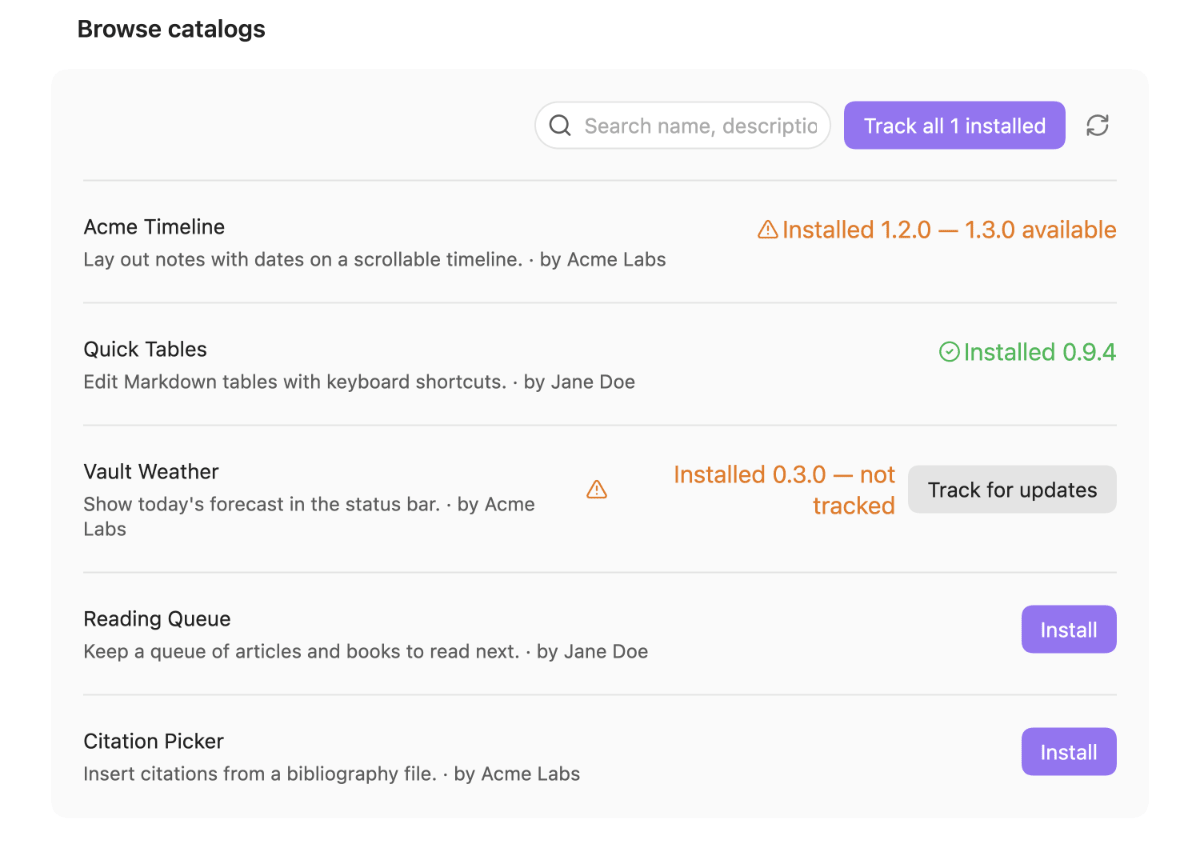 **Already have plugins installed?** They are recognised, not ignored. A catalog entry whose
plugin is already present offers **Track for updates** instead of Install, and **Track all N
installed** does the whole set. This matters because update checks only cover *tracked* plugins.
→ [Adopt existing plugins](https://github.com/johannes-kaindl/anysource-sideloader/blob/main/docs/how-to/adopt-existing-plugins.md)
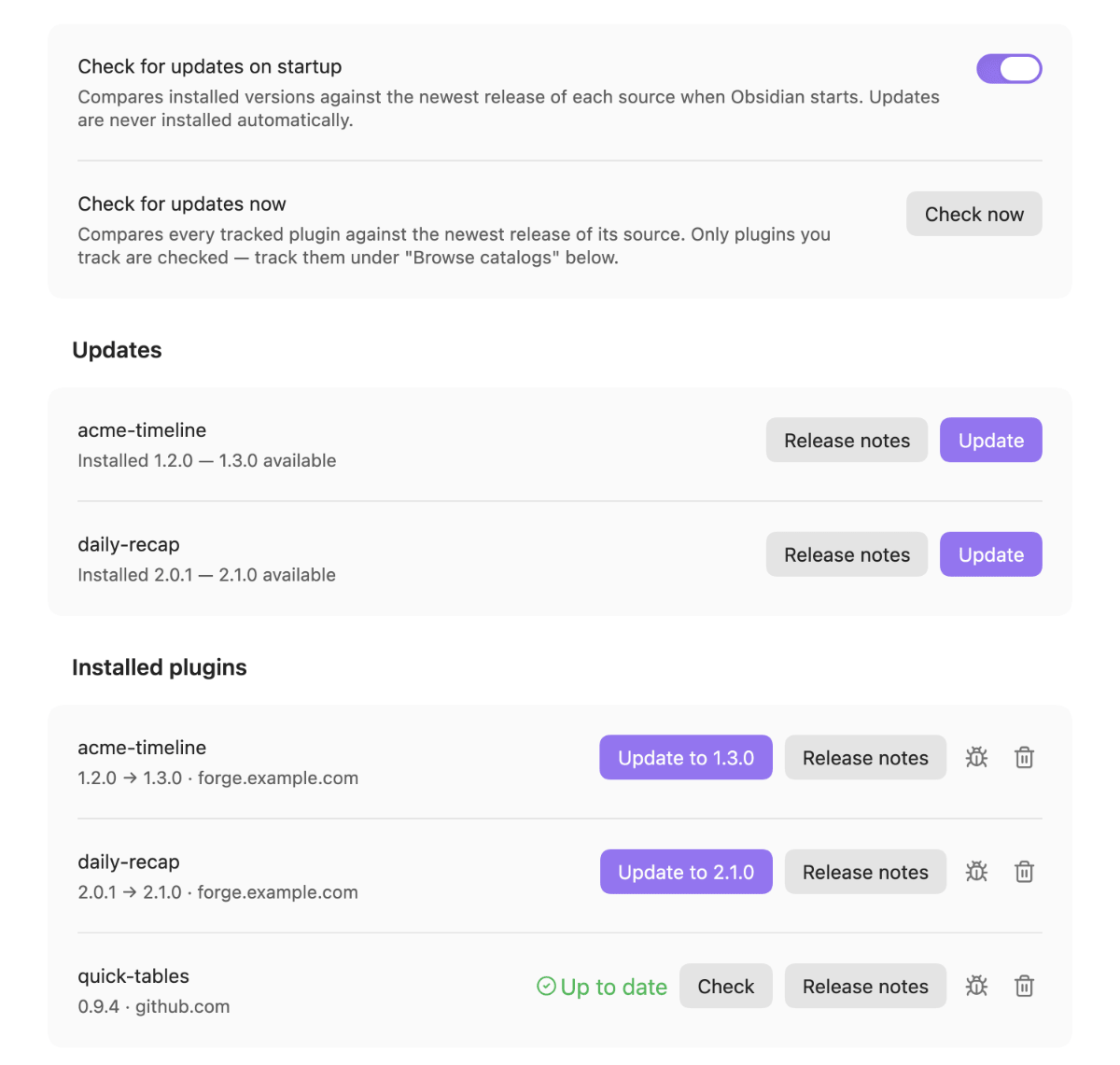
**Check and update.** **Check now**, the `check-updates` command, or once on startup. Each row
carries its own button — **Check** while nothing is pending, **Update to ``** once a
newer release is known. Release notes are shown before anything is applied, and nothing is
applied without confirmation. The Sideloader updates itself the same way. → [Keep plugins up to
date](https://github.com/johannes-kaindl/anysource-sideloader/blob/main/docs/how-to/update-plugins.md)
**Private repositories.** Tokens are stored per forge host in Obsidian's keychain — never in
`data.json`, never in plain text. → [Private
repositories](https://github.com/johannes-kaindl/anysource-sideloader/blob/main/docs/how-to/private-repositories.md)
**Already have plugins installed?** They are recognised, not ignored. A catalog entry whose
plugin is already present offers **Track for updates** instead of Install, and **Track all N
installed** does the whole set. This matters because update checks only cover *tracked* plugins.
→ [Adopt existing plugins](https://github.com/johannes-kaindl/anysource-sideloader/blob/main/docs/how-to/adopt-existing-plugins.md)
**Check and update.** **Check now**, the `check-updates` command, or once on startup. Each row
carries its own button — **Check** while nothing is pending, **Update to ``** once a
newer release is known. Release notes are shown before anything is applied, and nothing is
applied without confirmation. The Sideloader updates itself the same way. → [Keep plugins up to
date](https://github.com/johannes-kaindl/anysource-sideloader/blob/main/docs/how-to/update-plugins.md)
**Private repositories.** Tokens are stored per forge host in Obsidian's keychain — never in
`data.json`, never in plain text. → [Private
repositories](https://github.com/johannes-kaindl/anysource-sideloader/blob/main/docs/how-to/private-repositories.md)
 ## Configuration
Two things are configurable, both in the plugin's settings tab:
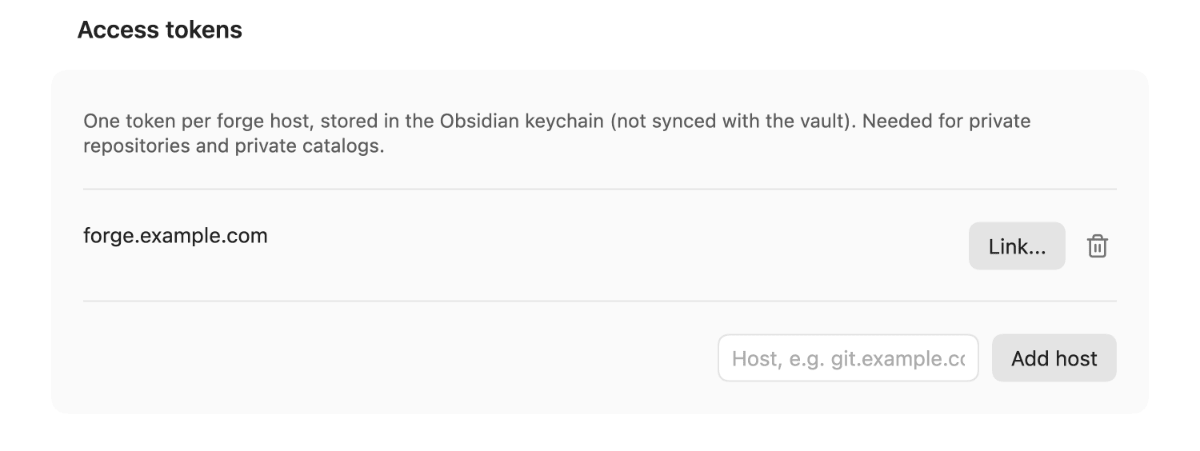
- **Access tokens**, per forge host. Private repos and private catalogs need one. Tokens go
into Obsidian's own keychain via the built-in `SecretComponent` — never into `data.json`,
never in plain text. A token is sent to every source on the host it belongs to, and to no
other host. This is what makes the organisation case work: a private Forgejo/Gitea instance
with internal plugins and one catalog, and members authenticating with a host-scoped token.
- **Check for updates on startup** (on by default). Runs one check shortly after Obsidian
starts. It reads only; nothing is ever applied without confirmation.
Full list of settings, commands and what is written to `data.json`: [Settings and
commands](https://github.com/johannes-kaindl/anysource-sideloader/blob/main/docs/reference/settings-and-commands.md).
## How it works
- When a release carries a `checksums.sha256` file, every downloaded asset is verified against
it before installation; a mismatch blocks the install.
- No silent auto-updates: every update is a deliberate, visible action, preceded by the release
notes of the new version.
- An id-change guard prevents a malicious or misconfigured release from silently swapping out
the plugin id an install is bound to.
What checksums do and do not prove is set out in [the security
model](https://github.com/johannes-kaindl/anysource-sideloader/blob/main/docs/explanation/security-model.md) — worth reading before installing anything you did
not write.
## Documentation
- **[Documentation index](https://github.com/johannes-kaindl/anysource-sideloader/blob/main/docs/README.md)** — tutorial, how-to guides, reference and explanation.
- **[Getting started](https://github.com/johannes-kaindl/anysource-sideloader/blob/main/docs/tutorial.md)** — from nothing to your first sideloaded plugin.
- **[Troubleshooting](https://github.com/johannes-kaindl/anysource-sideloader/blob/main/docs/how-to/troubleshooting.md)** — a message or symptom, its cause, and what to do.
## Known limitations
Installing a plugin runs third-party code with full Obsidian API access, and the install
dialog is the only gate; checksums prove transport integrity, not authenticity. Private
GitHub sources are experimental for a measured reason, and the raw fallback only knows the
branch names `main` and `master`.
The complete list, with what is measured and what is not, is in [Known
limitations](https://github.com/johannes-kaindl/anysource-sideloader/blob/main/docs/explanation/limitations.md) and [the security
model](https://github.com/johannes-kaindl/anysource-sideloader/blob/main/docs/explanation/security-model.md).
## License
- **Code:** AGPL-3.0-or-later ([`LICENSE`](https://github.com/johannes-kaindl/anysource-sideloader/blob/main/LICENSE)).
- **No runtime dependencies.** Vendored build/test helpers from the author's own
`obsidian-kit`/`code-kit` carry their provenance headers in `src/vendor/`.
## Configuration
Two things are configurable, both in the plugin's settings tab:
- **Access tokens**, per forge host. Private repos and private catalogs need one. Tokens go
into Obsidian's own keychain via the built-in `SecretComponent` — never into `data.json`,
never in plain text. A token is sent to every source on the host it belongs to, and to no
other host. This is what makes the organisation case work: a private Forgejo/Gitea instance
with internal plugins and one catalog, and members authenticating with a host-scoped token.
- **Check for updates on startup** (on by default). Runs one check shortly after Obsidian
starts. It reads only; nothing is ever applied without confirmation.
Full list of settings, commands and what is written to `data.json`: [Settings and
commands](https://github.com/johannes-kaindl/anysource-sideloader/blob/main/docs/reference/settings-and-commands.md).
## How it works
- When a release carries a `checksums.sha256` file, every downloaded asset is verified against
it before installation; a mismatch blocks the install.
- No silent auto-updates: every update is a deliberate, visible action, preceded by the release
notes of the new version.
- An id-change guard prevents a malicious or misconfigured release from silently swapping out
the plugin id an install is bound to.
What checksums do and do not prove is set out in [the security
model](https://github.com/johannes-kaindl/anysource-sideloader/blob/main/docs/explanation/security-model.md) — worth reading before installing anything you did
not write.
## Documentation
- **[Documentation index](https://github.com/johannes-kaindl/anysource-sideloader/blob/main/docs/README.md)** — tutorial, how-to guides, reference and explanation.
- **[Getting started](https://github.com/johannes-kaindl/anysource-sideloader/blob/main/docs/tutorial.md)** — from nothing to your first sideloaded plugin.
- **[Troubleshooting](https://github.com/johannes-kaindl/anysource-sideloader/blob/main/docs/how-to/troubleshooting.md)** — a message or symptom, its cause, and what to do.
## Known limitations
Installing a plugin runs third-party code with full Obsidian API access, and the install
dialog is the only gate; checksums prove transport integrity, not authenticity. Private
GitHub sources are experimental for a measured reason, and the raw fallback only knows the
branch names `main` and `master`.
The complete list, with what is measured and what is not, is in [Known
limitations](https://github.com/johannes-kaindl/anysource-sideloader/blob/main/docs/explanation/limitations.md) and [the security
model](https://github.com/johannes-kaindl/anysource-sideloader/blob/main/docs/explanation/security-model.md).
## License
- **Code:** AGPL-3.0-or-later ([`LICENSE`](https://github.com/johannes-kaindl/anysource-sideloader/blob/main/LICENSE)).
- **No runtime dependencies.** Vendored build/test helpers from the author's own
`obsidian-kit`/`code-kit` carry their provenance headers in `src/vendor/`.