# MediaFerry
> Turn article, audio, and video links into notes — right where they belong: your Obsidian Vault.
**English** · [中文](README.zh-CN.md) — [Engineering ›](ENGINEERING.md)
[](https://github.com/fyaic/MediaFerry-Obsidian-Plugin/releases/latest)
[](https://github.com/fyaic/MediaFerry-Obsidian-Plugin/actions/workflows/ci.yml)
[](manifest.json)
[](LICENSE)
You find something worth keeping — an article, a podcast episode, a video. Today that
means a link rotting in a chat thread or a read-later app you never reopen.
MediaFerry turns that link into a real Markdown note inside your Vault. One paste,
and the content becomes something you can read, edit, link, and search — in the app you
already live in.
It runs on desktop **and** on your phone — and the phone is the design target, not an
afterthought. Every flow is built for one hand, a small screen, and the messy reality
of mobile connections.
## One field for every link
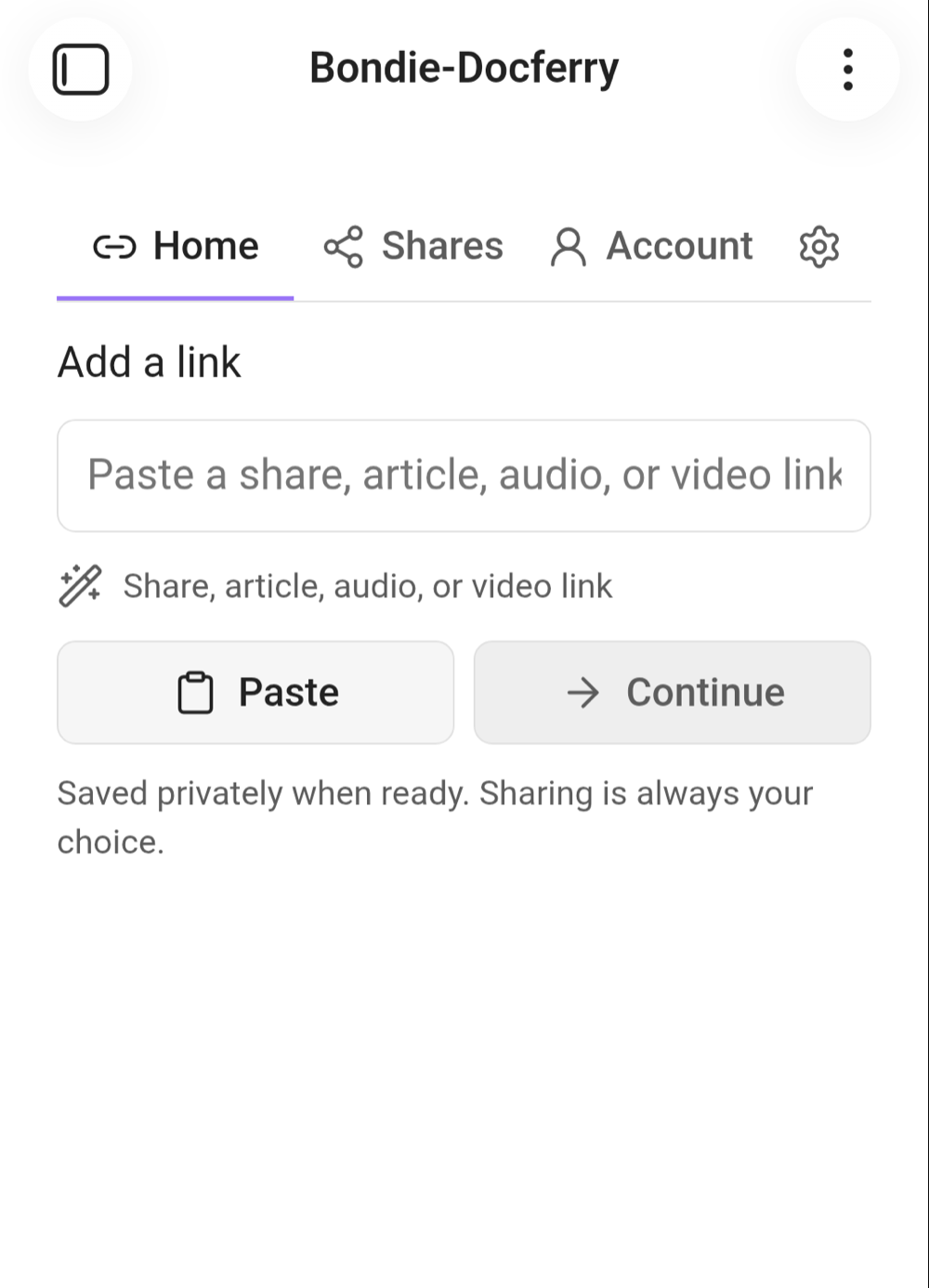 **One place to start.** Paste a public DocFerry link, an article, an audio, or a video URL.
- The field tells you what it recognized and what will happen — the button becomes
**Import** or **Create note** — before you commit.
- **Paste** pulls from your clipboard in one tap. Nothing reads your clipboard on its own.
- While it works, you see plain-language progress: *Reading the link → Preparing the
transcript → Organizing key ideas → Writing your note.*
## From link to a note you own
Paste a video link in the morning, and by the time you sit down, this is in your Vault:
```
Bondie Docferry/
└── 2026-08-14 How I organize my research.md
```
- **Plain Markdown, nothing else.** No proprietary format, no frontmatter you didn't
ask for. The note works in Obsidian, on GitHub, in any editor — forever.
- **You choose where notes land.** Settings offer one folder for generated notes and one
for imports (defaults: `Bondie Docferry` and `Bondie Docferry/Imports`).
- **Preview before it's final.** Title, summary, source site, rendered content — plus the
raw Markdown source if you want to see exactly what you're getting.
- **Save note**, **Copy note**, or go straight to creating a public link — all from the
preview.
## Private first — sharing is always a separate choice
**One place to start.** Paste a public DocFerry link, an article, an audio, or a video URL.
- The field tells you what it recognized and what will happen — the button becomes
**Import** or **Create note** — before you commit.
- **Paste** pulls from your clipboard in one tap. Nothing reads your clipboard on its own.
- While it works, you see plain-language progress: *Reading the link → Preparing the
transcript → Organizing key ideas → Writing your note.*
## From link to a note you own
Paste a video link in the morning, and by the time you sit down, this is in your Vault:
```
Bondie Docferry/
└── 2026-08-14 How I organize my research.md
```
- **Plain Markdown, nothing else.** No proprietary format, no frontmatter you didn't
ask for. The note works in Obsidian, on GitHub, in any editor — forever.
- **You choose where notes land.** Settings offer one folder for generated notes and one
for imports (defaults: `Bondie Docferry` and `Bondie Docferry/Imports`).
- **Preview before it's final.** Title, summary, source site, rendered content — plus the
raw Markdown source if you want to see exactly what you're getting.
- **Save note**, **Copy note**, or go straight to creating a public link — all from the
preview.
## Private first — sharing is always a separate choice
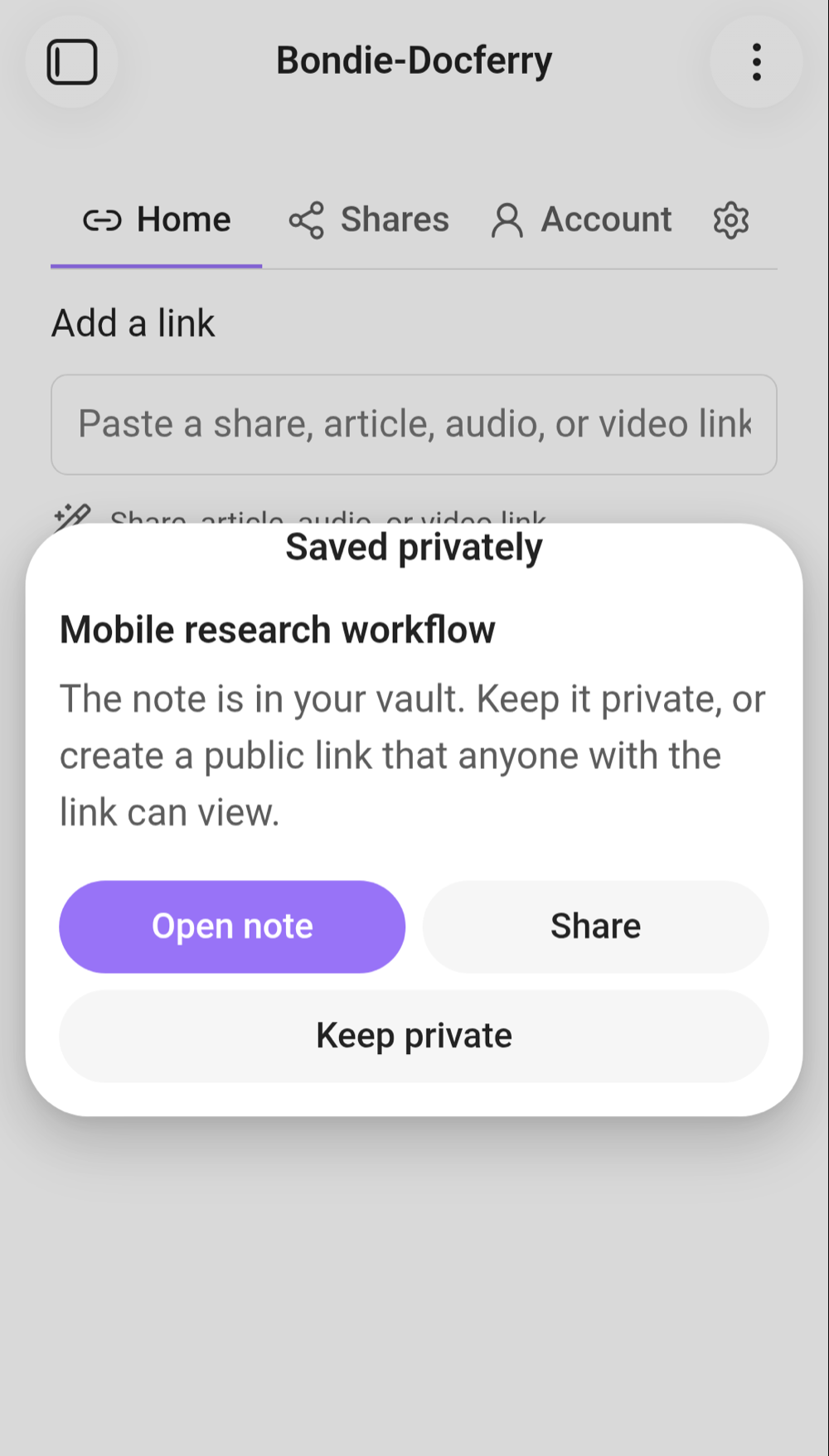 **Private by default.** Open the note, share it, or simply keep it private.
- Every finished note is saved privately first. No public link exists unless you create one.
- When the note is ready, you choose: **Open note**, **Share**, or **Keep private**.
- Sharing asks before it acts, in plain words: *"Anyone with the link can view this
note. Your vault and account details are not shared."*
## Share without losing control
**Private by default.** Open the note, share it, or simply keep it private.
- Every finished note is saved privately first. No public link exists unless you create one.
- When the note is ready, you choose: **Open note**, **Share**, or **Keep private**.
- Sharing asks before it acts, in plain words: *"Anyone with the link can view this
note. Your vault and account details are not shared."*
## Share without losing control
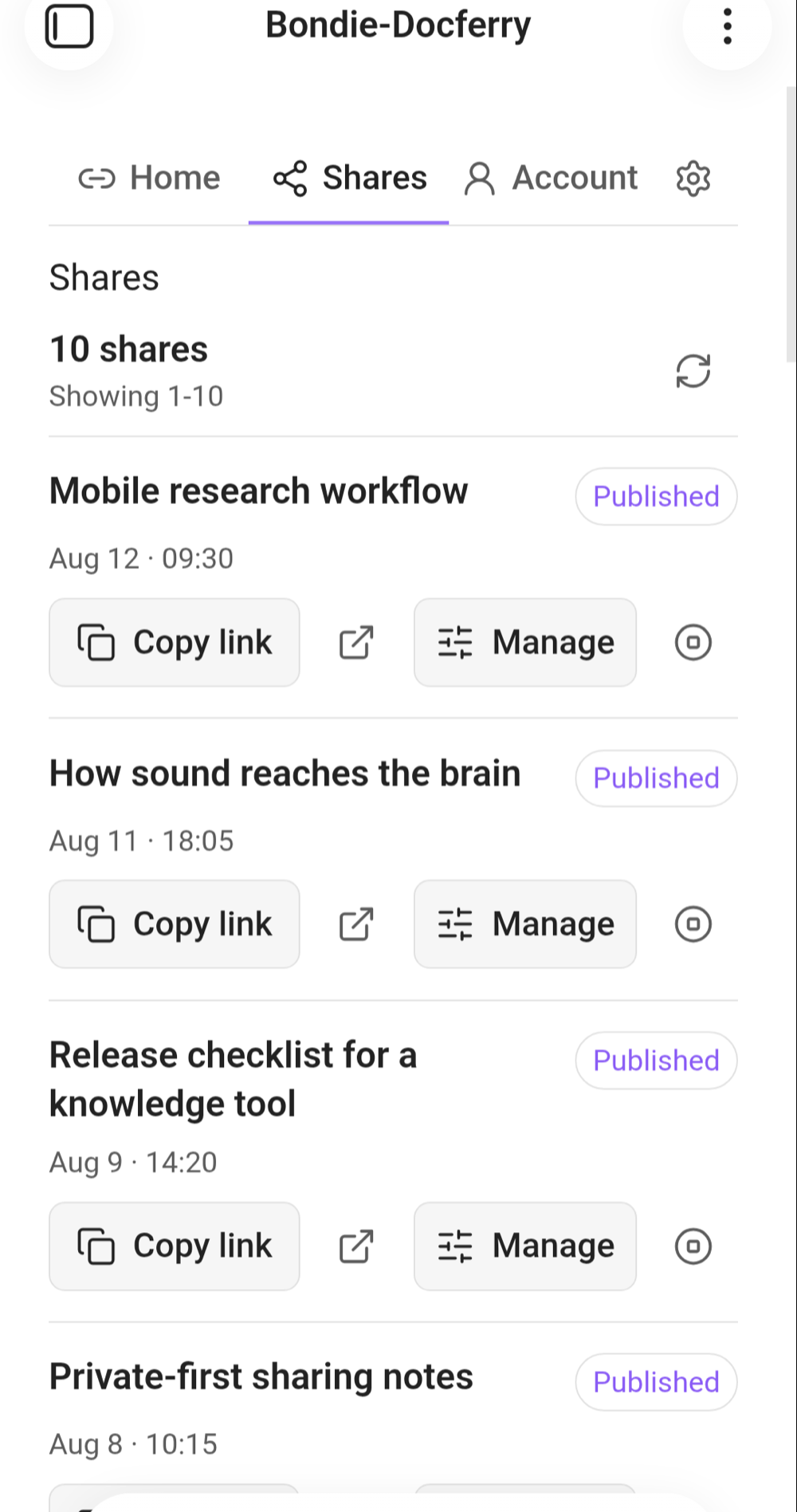 **Your links, your rules.** Copy, open, update, stop, or delete Share history.
- Every public link you create shows up in **Shares** with a clear status:
*Published · Password protected · Expired · Stopped*.
- **Manage** a link: change its title, add or remove a password, set or clear an expiry date.
- **Stop** a link any time. The note stays in your Vault; the link stops working for everyone.
- Tidy up afterwards: delete the history records of stopped or expired shares without
touching your notes.
## Built mobile-first — at home on your phone and desktop
MediaFerry works everywhere Obsidian does. Mobile isn't a shrink-to-fit port: the
link field, progress states, and recovery flows are designed for one thumb and an
interrupted connection.
Phones interrupt you — calls, app switches, dead batteries. MediaFerry doesn't lose
your work.
- **Come back to finished work.** Processing happens on the service, so if you switch
apps mid-job, the note picks up where it left off when you return (kept for 24 hours).
- **Cancel, retry, or delete.** Change your mind mid-processing? Cancel it. A note failed
on a bad connection? Retry it. Want the temporary data gone? Delete it from
*Account → Processing data*.
- **Flaky network tolerance.** Brief connection drops trigger an automatic reconnect with
a status you can understand, not a dead spinner.
## Import a DocFerry note from someone else
Someone sent you a note via a public DocFerry link? You don't need to be the author to
keep it.
- Paste the share link — it imports as a note, **including its attachments**, into your
imports folder.
- **Free, no account needed.** Share import works signed out.
- Paste the same link twice? It opens the existing note instead of duplicating it.
## Know where you stand
**Your links, your rules.** Copy, open, update, stop, or delete Share history.
- Every public link you create shows up in **Shares** with a clear status:
*Published · Password protected · Expired · Stopped*.
- **Manage** a link: change its title, add or remove a password, set or clear an expiry date.
- **Stop** a link any time. The note stays in your Vault; the link stops working for everyone.
- Tidy up afterwards: delete the history records of stopped or expired shares without
touching your notes.
## Built mobile-first — at home on your phone and desktop
MediaFerry works everywhere Obsidian does. Mobile isn't a shrink-to-fit port: the
link field, progress states, and recovery flows are designed for one thumb and an
interrupted connection.
Phones interrupt you — calls, app switches, dead batteries. MediaFerry doesn't lose
your work.
- **Come back to finished work.** Processing happens on the service, so if you switch
apps mid-job, the note picks up where it left off when you return (kept for 24 hours).
- **Cancel, retry, or delete.** Change your mind mid-processing? Cancel it. A note failed
on a bad connection? Retry it. Want the temporary data gone? Delete it from
*Account → Processing data*.
- **Flaky network tolerance.** Brief connection drops trigger an automatic reconnect with
a status you can understand, not a dead spinner.
## Import a DocFerry note from someone else
Someone sent you a note via a public DocFerry link? You don't need to be the author to
keep it.
- Paste the share link — it imports as a note, **including its attachments**, into your
imports folder.
- **Free, no account needed.** Share import works signed out.
- Paste the same link twice? It opens the existing note instead of duplicating it.
## Know where you stand
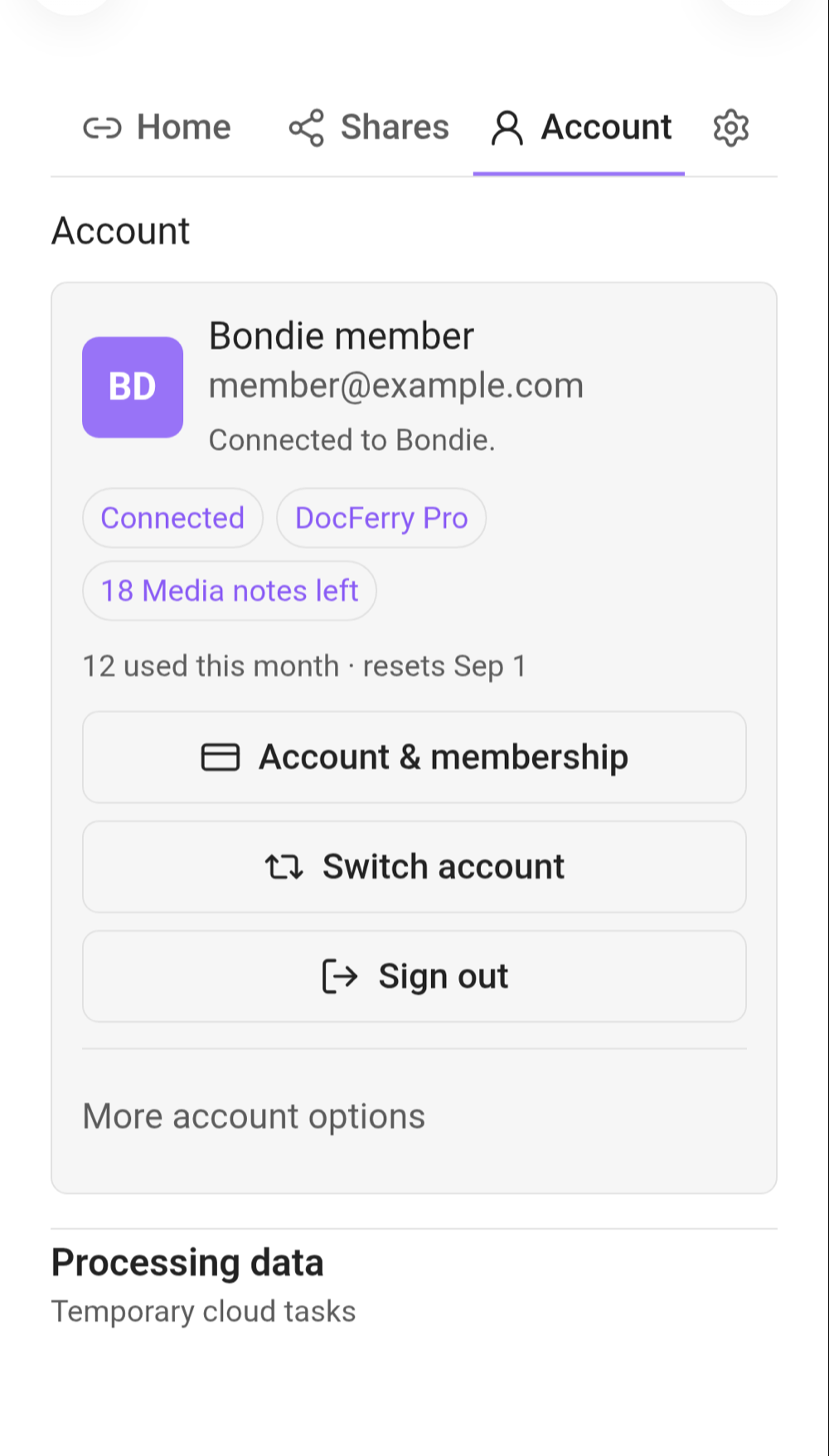 **Useful account status.** Identity, membership, and usage without exposing keys.
- Sign in with your Bondie account; see who you're signed in as at a glance.
- Membership in plain words: **DocFerry Pro** or **Free**.
- Usage in real numbers: *"5 Media notes left · resets Sep 1"* — no guessing.
- Membership and account management live in the Bondie Account Center, one tap away.
> These four screens were captured from the release candidate running in Obsidian 1.12.7
> on a physical Android phone. Account details, usage values, and Share content were
> replaced before capture.
## Your notes stay yours
- **No lock-in.** Notes are ordinary Markdown files in folders you chose. Disable or
uninstall the plugin — the notes are still there, still readable.
- **Your Vault is not scanned.** The plugin writes only the notes it creates or imports.
It never reads or uploads the rest of your Vault.
- **No telemetry, no ads.** Nothing about your usage leaves the plugin client.
- **Your session is safe.** Sign-in is stored with Obsidian's own SecretStorage. AI
provider keys and payment secrets never touch the plugin.
## Get started
1. You need Obsidian **1.11.4 or later**, on mobile or desktop.
2. **Current status: release candidate.** MediaFerry is under Community plugin
review and not yet in the official directory. The simplest path is to wait for the
directory listing.
3. Testers and reviewers can install manually: download `main.js`, `manifest.json`, and
`styles.css` from the [latest release](https://github.com/fyaic/MediaFerry-Obsidian-Plugin/releases),
drop them into `/.obsidian/plugins/bondie-docferry/`, restart Obsidian, and
enable MediaFerry in Community plugins.
4. Tap the **ship icon** in the ribbon (or run **Open home**), paste your first link,
and watch it become a note.
Share import works immediately, no account. Turning articles, audio, and video into
notes requires a free Bondie account and a DocFerry Pro membership — see below.
**Identity correction in 0.1.4.** MediaFerry is the display name; the registered
Community ID remains `bondie-docferry`. Existing installs under that ID update
in place. Manual testers of 0.1.3 should read the backup-first migration in
[the release notes](RELEASE_NOTES.md); do not delete your plugin configuration.
## Good to know
**Pricing.** Importing public DocFerry shares is free and needs no account. The
Media-to-Note workflow (links → notes), owner Shares, and usage tracking require a
Bondie account with DocFerry Pro. One membership covers both MediaFerry and
DocFerry — the plugin never sells a second subscription. Current pricing and billing
are shown by the Bondie Account Center and DocFerry checkout.
**Disclosures** (required for Obsidian Community plugins):
- **Payment:** `Paid`. Share import is free; Media-to-Note requires DocFerry Pro.
- **Account:** required for Media-to-Note, owner Shares, usage, and account controls.
Public Share import works signed out.
- **Network:** submitted links and signed-in actions use hosted Bondie, SynapseHub, and
DocFerry services. Account avatars and validated source thumbnails load over HTTPS
from their image hosts.
- **Vault access:** the plugin writes only generated/imported notes and declared assets
to your chosen folders. It does not scan unrelated Vault files.
- **Clipboard:** accessed only after your explicit **Paste** or **Copy** action.
- **Telemetry and ads:** none in the plugin client.
- **Source availability:** this client is MIT-licensed and public. Hosted service source
is closed and not part of this repository.
Full details: [Privacy notice](PRIVACY.md) · [Security policy](SECURITY.md) ·
[Support & subscriptions](SUPPORT.md).
**Compatibility.** Obsidian 1.11.4+ · works on desktop and on mobile · Android and
desktop tested · no Node.js or Electron dependency.
## Project links
[Latest release](https://github.com/fyaic/MediaFerry-Obsidian-Plugin/releases/latest) ·
[Changelog](CHANGELOG.md) · [Support](SUPPORT.md) · [Contributing](CONTRIBUTING.md) ·
[Privacy](PRIVACY.md) · [Security](SECURITY.md) · [Engineering docs](ENGINEERING.md)
## License
The public plugin client is released under the [MIT License](LICENSE). Hosted service
source is closed and is not part of this repository.
**Useful account status.** Identity, membership, and usage without exposing keys.
- Sign in with your Bondie account; see who you're signed in as at a glance.
- Membership in plain words: **DocFerry Pro** or **Free**.
- Usage in real numbers: *"5 Media notes left · resets Sep 1"* — no guessing.
- Membership and account management live in the Bondie Account Center, one tap away.
> These four screens were captured from the release candidate running in Obsidian 1.12.7
> on a physical Android phone. Account details, usage values, and Share content were
> replaced before capture.
## Your notes stay yours
- **No lock-in.** Notes are ordinary Markdown files in folders you chose. Disable or
uninstall the plugin — the notes are still there, still readable.
- **Your Vault is not scanned.** The plugin writes only the notes it creates or imports.
It never reads or uploads the rest of your Vault.
- **No telemetry, no ads.** Nothing about your usage leaves the plugin client.
- **Your session is safe.** Sign-in is stored with Obsidian's own SecretStorage. AI
provider keys and payment secrets never touch the plugin.
## Get started
1. You need Obsidian **1.11.4 or later**, on mobile or desktop.
2. **Current status: release candidate.** MediaFerry is under Community plugin
review and not yet in the official directory. The simplest path is to wait for the
directory listing.
3. Testers and reviewers can install manually: download `main.js`, `manifest.json`, and
`styles.css` from the [latest release](https://github.com/fyaic/MediaFerry-Obsidian-Plugin/releases),
drop them into `/.obsidian/plugins/bondie-docferry/`, restart Obsidian, and
enable MediaFerry in Community plugins.
4. Tap the **ship icon** in the ribbon (or run **Open home**), paste your first link,
and watch it become a note.
Share import works immediately, no account. Turning articles, audio, and video into
notes requires a free Bondie account and a DocFerry Pro membership — see below.
**Identity correction in 0.1.4.** MediaFerry is the display name; the registered
Community ID remains `bondie-docferry`. Existing installs under that ID update
in place. Manual testers of 0.1.3 should read the backup-first migration in
[the release notes](RELEASE_NOTES.md); do not delete your plugin configuration.
## Good to know
**Pricing.** Importing public DocFerry shares is free and needs no account. The
Media-to-Note workflow (links → notes), owner Shares, and usage tracking require a
Bondie account with DocFerry Pro. One membership covers both MediaFerry and
DocFerry — the plugin never sells a second subscription. Current pricing and billing
are shown by the Bondie Account Center and DocFerry checkout.
**Disclosures** (required for Obsidian Community plugins):
- **Payment:** `Paid`. Share import is free; Media-to-Note requires DocFerry Pro.
- **Account:** required for Media-to-Note, owner Shares, usage, and account controls.
Public Share import works signed out.
- **Network:** submitted links and signed-in actions use hosted Bondie, SynapseHub, and
DocFerry services. Account avatars and validated source thumbnails load over HTTPS
from their image hosts.
- **Vault access:** the plugin writes only generated/imported notes and declared assets
to your chosen folders. It does not scan unrelated Vault files.
- **Clipboard:** accessed only after your explicit **Paste** or **Copy** action.
- **Telemetry and ads:** none in the plugin client.
- **Source availability:** this client is MIT-licensed and public. Hosted service source
is closed and not part of this repository.
Full details: [Privacy notice](PRIVACY.md) · [Security policy](SECURITY.md) ·
[Support & subscriptions](SUPPORT.md).
**Compatibility.** Obsidian 1.11.4+ · works on desktop and on mobile · Android and
desktop tested · no Node.js or Electron dependency.
## Project links
[Latest release](https://github.com/fyaic/MediaFerry-Obsidian-Plugin/releases/latest) ·
[Changelog](CHANGELOG.md) · [Support](SUPPORT.md) · [Contributing](CONTRIBUTING.md) ·
[Privacy](PRIVACY.md) · [Security](SECURITY.md) · [Engineering docs](ENGINEERING.md)
## License
The public plugin client is released under the [MIT License](LICENSE). Hosted service
source is closed and is not part of this repository.