# Bases Enhancements
**Your favorite views, one click away. Cleaner boards. Notes in the right place.**
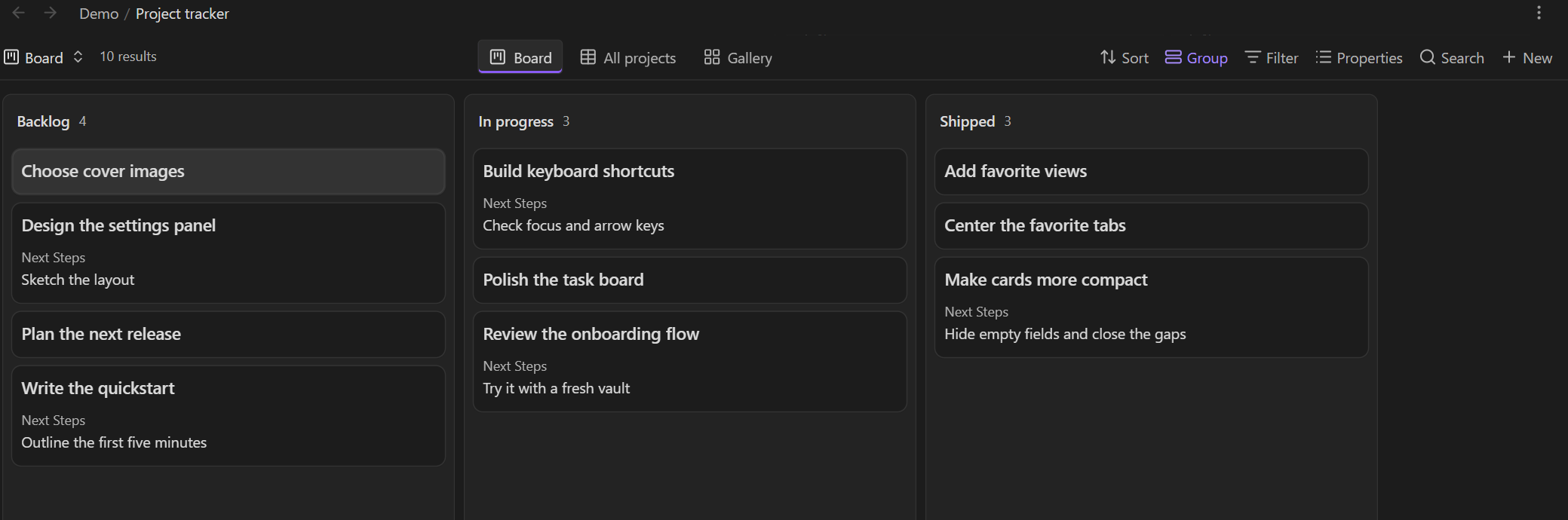
Bring your most-used views to the front of Obsidian Bases and keep your boards focused on what matters. Star the views you reach for every day, switch between them from centered tabs, and let Kanban cards shrink around their content.
## Features
- **Keep your favorite views in reach.** Star any saved view from the view dropdown or **Configure view**. Your favorites appear as centered tabs above the base.
- **Switch layouts without breaking your flow.** Jump between Table, Kanban, Cards, List, and registered community layouts from the same tab bar.
- **See the next step, skip the empty space.** Hide empty Kanban fields, including their labels and placeholders. Cards shrink to fit, and the column closes the gaps.
- **Make clickable cards feel clickable.** A subtle hover highlight and pointer cursor make the board easier to scan and use. Keyboard focus stays visible.
- **Arrange tabs your way.** Drag favorites to reorder them, use keyboard shortcuts, or open their context menu. The native view list keeps its original order.
- **Take your favorites with you.** Favorites belong to each base and follow file sync, moves, and view renames. Multiple panes share favorites while keeping their selected views independent.
- **Keep new notes with their project.** Use Obsidian's native folder filters so **New** creates notes in the view's folder. See the [folder setup](#create-notes-in-the-filtered-folder).
- **Keep working in small spaces.** The tab bar scrolls horizontally in narrow panes and works in standalone bases and file-backed Markdown embeds.
## Star a view. Get back to it instantly.
1. Open a `.base` file and click its view dropdown.
2. Click the star beside a view, or open **Configure view** and turn on **Star view**.
3. Click its favorite tab whenever you want to return to it.
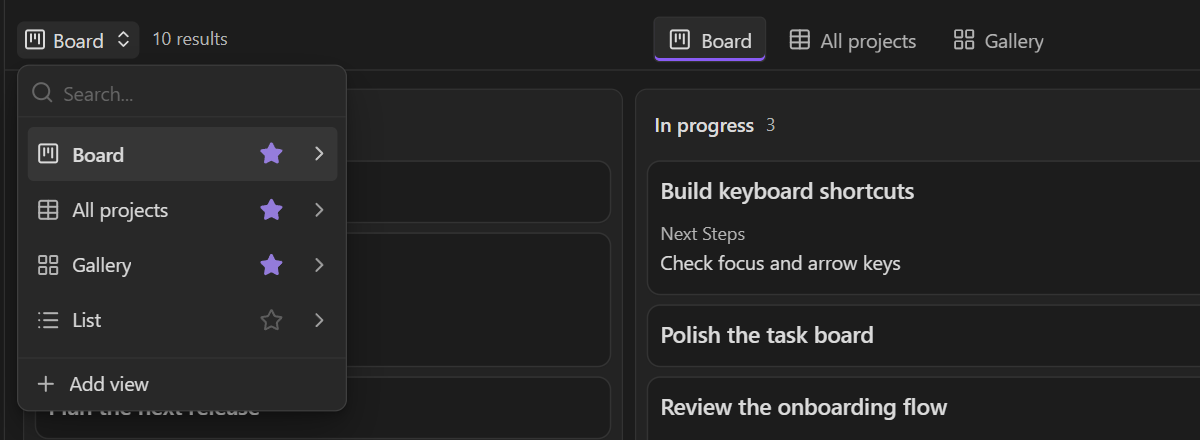 A filled star means the view is a favorite. Click it to unstar the view; click an outlined star to add it. Unstarring the current view leaves it open, and the native dropdown always lists every view.
| Action | Control |
| --- | --- |
| Open a favorite | Click its tab, or focus it and press Enter or Space |
| Reorder favorites | Drag a tab, or press Alt+Left / Alt+Right while it is focused |
| Move keyboard focus | Left / Right, Home, or End |
| Unstar or reorder a view | Right-click its tab |
| Toggle the current view's star | Run **Bases Enhancements: Toggle star for current Bases view** from the command palette |
## Less empty space. More of your board.
An empty **Next Steps** field shouldn't make a card taller. **Hide empty fields** is enabled by default for native Kanban views: missing values, blank text, and empty lists disappear together with their labels and placeholders. Cards pack together at their natural heights.
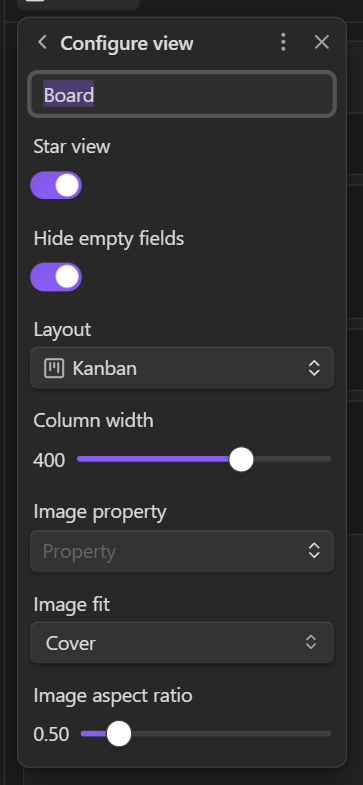 Want the original layout for a particular board? Turn **Hide empty fields** off in that view's **Configure view** popup. Zero values and unchecked checkboxes remain visible. Native rendering, virtualization, and drag-and-drop are retained, and reduced-motion preferences are respected.
## Create notes in the filtered folder
Keep a project's notes together from the moment you create them. Obsidian supports this natively when a view uses a folder filter.
For a view scoped to one folder, add a rule like this to its `filters` in the `.base` file:
```yaml
views:
- type: kanban
name: Projects
filters:
and:
- file.inFolder("Projects/Tasks")
- file.ext == "md"
```
Click **New** to create a note in `Projects/Tasks`, even when your vault's default location is the root. This works with Table, Kanban, Cards, and List views.
- Use `file.inFolder("Projects/Tasks")` to include notes in that folder and its subfolders.
- Use `file.folder == "Projects/Tasks"` to show only notes directly in that folder.
- Put the folder rule under **This view** when views use different folders, or **All views** to share one folder across the base. See [Obsidian's filter documentation](https://obsidian.md/help/bases/views#Filters).
In Obsidian 1.14.4, `file.path.contains(...)` and `file.path.startsWith(...)` narrow results but do not set the new-note folder. Use one of the folder rules above for folder-aware creation. This is native Obsidian behavior and works with Bases Enhancements disabled too.
### Keep new Kanban cards visible
The native **New** button also carries over property defaults from the view's filters, such as `Source == ["Home"]`. Adding a folder rule preserves that behavior.
A ticket can match the filter and still be hidden if it has no `Status` and the board hides the unassigned group. If you use a manual column order, show the unassigned group in the **Group** menu, or include `null` in the view's `groupOrder`:
```yaml
groupBy:
property: Status
direction: ASC
groupOrder:
- null
- ToDo
- In Progress
- Waiting
- Done
```
New tickets appear in the unassigned column with their inherited properties intact. Creating a ticket from a column's **New** button also assigns that column's value.
## Install
Requires **Obsidian 1.14.4 or later** with the **Bases** core plugin enabled. You can use it alongside [Bases Board View](https://github.com/DannieBGoode/obsidian-board-bases-plugin) and other community layouts. Empty-field controls apply to native Kanban views.
See the [Obsidian Community listing](https://community.obsidian.md/plugins/bases-view-favorites) for screenshots and release review details. You can also install the plugin directly from GitHub below.
### Install from Community plugins
Open the [community listing](https://community.obsidian.md/plugins/bases-view-favorites), choose **Add to Obsidian**, then **Install** and **Enable**.
### Download the latest release
1. Open the [latest release](https://github.com/DannieBGoode/obsidian-bases-enhancements/releases/latest) and download `main.js`, `manifest.json`, and `styles.css` from **Assets**.
2. Place the three files in `/.obsidian/plugins/bases-view-favorites/`.
3. Reload Obsidian, then enable **Bases Enhancements** under **Settings → Community plugins**.
The plugin keeps its original `bases-view-favorites` ID so existing installations and command bindings continue to work.
### Build from source
With Node.js **22 or later** installed:
```sh
git clone https://github.com/DannieBGoode/obsidian-bases-enhancements.git
cd obsidian-bases-enhancements
npm ci
npm run check
node scripts/install.mjs "/path/to/your/vault"
```
Reload Obsidian and enable **Bases Enhancements** under **Settings → Community plugins**. The installer copies the build from `dist/`. Add `--enable` to also add the plugin to the vault's enabled plugin list for the next reload.
## Privacy
Bases Enhancements works locally inside your vault. It makes no network requests, collects no telemetry, and requires no account or external service. It saves view preferences in your `.base` files.
## Storage and compatibility
Favorites are saved in the `.base` file, so each board, reading list, or project tracker can have its own shortcuts. Disabling the plugin removes its interface and keeps your preferences for later.
Configuration details
Favorite order is stored on each view:
```yaml
views:
- type: table
name: Home
viewFavorites:
order: 0
```
The Kanban empty-field preference is stored as `bvfHideEmptyFields` on the view, independently of whether it is starred. Note contents are unaffected by these preferences.
File-backed Markdown embeds are supported. Inline `base` code blocks use a different save lifecycle and are outside the current scope. Desktop behavior was verified on Windows with Obsidian 1.14.4; narrow desktop panes were checked down to 480 pixels. Mobile hardware has not been tested.
## Development
Run `npm ci` and `npm run check`. The checks cover TypeScript, unit tests, and the production build; CI runs them on Windows and Linux. Build artifacts are written to `dist/`.
See [TESTING.md](TESTING.md) for real Obsidian smoke tests, native folder-creation checks, and compatibility notes. The integration uses private Obsidian APIs; rerun the native checks when updating Obsidian.
To prepare a release, keep `package.json`, `manifest.json`, and `versions.json` in sync and push a tag matching the manifest version exactly, such as `0.1.0`. The release workflow creates a draft release with the three plugin files. See [Obsidian's release guide](https://docs.obsidian.md/Plugins/Releasing/Release%20your%20plugin%20with%20GitHub%20Actions).
## Ideas or issues?
[Report a bug or suggest an improvement](https://github.com/DannieBGoode/obsidian-bases-enhancements/issues). Include your Obsidian version, layout type, and steps to reproduce. A small example base with sample notes helps reproduce the issue.
[MIT License](LICENSE) · Made by [DannieBGoode](https://github.com/DannieBGoode)