# Inkstone Annotations · 墨读标注
[简体中文](README.zh-CN.md) · English
**[Install from the Obsidian marketplace (recommended)](https://community.obsidian.md/plugins/inkstone-annotations)** · **[Installation and updates](#install-and-update)**
Manual download (alternative): [latest release](https://github.com/bufan1024/obsidian-inkstone-annotations/releases/latest) · [main.js](https://github.com/bufan1024/obsidian-inkstone-annotations/releases/latest/download/main.js) · [manifest.json](https://github.com/bufan1024/obsidian-inkstone-annotations/releases/latest/download/manifest.json) · [styles.css](https://github.com/bufan1024/obsidian-inkstone-annotations/releases/latest/download/styles.css).
## Demos
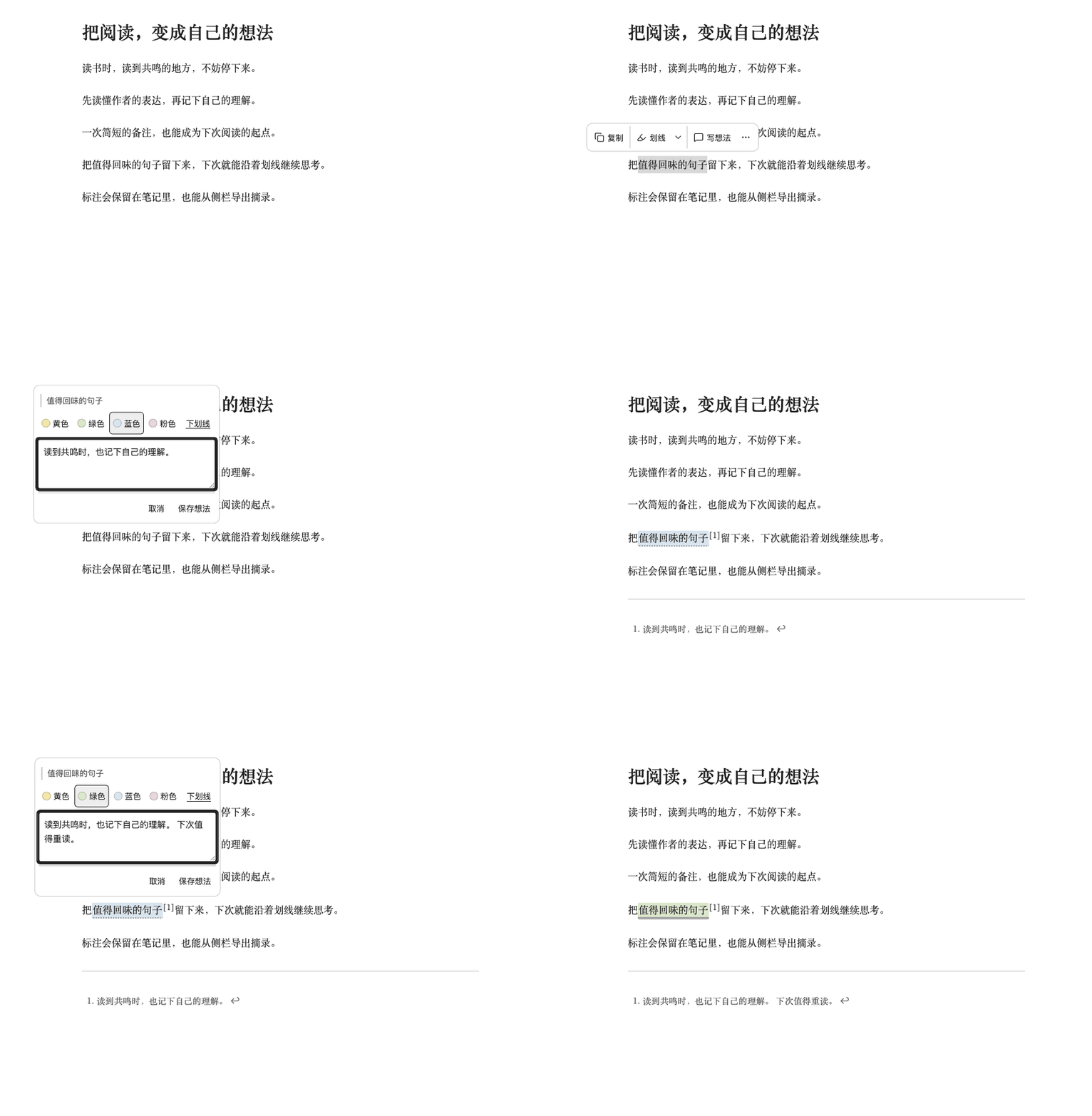
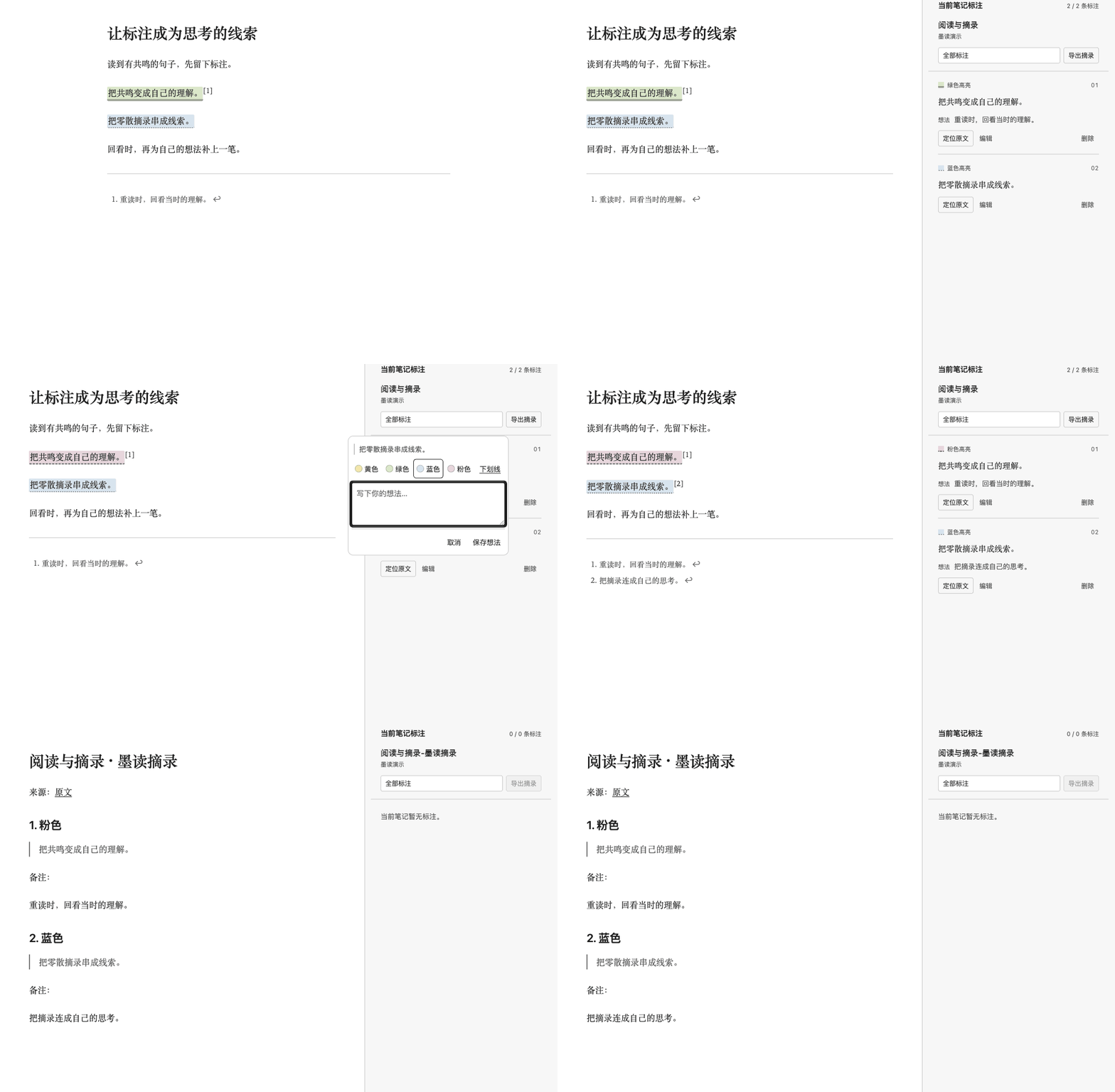
Underlines, four highlight colors, footnote thoughts, a current-note sidebar, and Markdown excerpt export for Obsidian. Plugin **1.2.0** is published; check the plugin marketplace page for this version's synchronization and review status. Companion theme **1.4.0** is published on [GitHub Releases](https://github.com/bufan1024/obsidian-inkstone/releases/tag/1.4.0); check the theme marketplace page for its sync and review status. Requires Obsidian **1.10.6 or later**.
Choose **简体中文** or **English** explicitly in the plugin settings. Chinese is the default; the choice does not follow Obsidian's language automatically. This guide includes the default Chinese labels so they remain easy to find.
Everything is processed locally through Obsidian APIs. No network calls, account, or other plugin is required. Live Preview uses CodeMirror bundled with Obsidian. Annotations are saved directly in Markdown and remain compatible with older Inkstone markup. The Inkstone theme is plain CSS and can be used separately.
**[Install the plugin in Obsidian](https://community.obsidian.md/plugins/inkstone-annotations)** · **[Install the companion theme](https://community.obsidian.md/themes/inkstone)**
## Install and update
### Recommended: install from Obsidian's community directory
Open the vault you want to use in Obsidian first. Community installation requires no Git, Python, or build tools. Install the plugin and theme separately as needed:
- **Plugin:** Open **Settings → Community plugins** and turn off **Restricted mode** if needed on first use. Choose **Browse**, search for **Inkstone Annotations** (plugin ID: `inkstone-annotations`), then select **Install → Enable**. You can also turn on its switch under **Installed plugins** after installation.
- **Companion theme:** Open **Settings → Appearance → Themes → Manage**, search for **Inkstone**, and choose **Install and use**. The theme supports **Light only**; set the color scheme to light. You can use the plugin without installing the theme.
Alternatively, open either community page above and choose **Add to Obsidian**, then finish in the target vault. Installing the theme does not install or enable the plugin. Once enabled, select plain text within one source line to see **「划线」 (Mark)** and **「写想法」 (Write a thought)**, or search the command palette for **「墨读:打开标注侧栏」** to open the sidebar.
### Update one component at a time
- **Plugin only:** Open **Settings → Community plugins → Current plugins → Check for updates**. Under **Installed plugins**, choose **Update** beside **Inkstone Annotations** only, then confirm its switch is still enabled.
- **Theme only:** Open **Settings → Appearance → Themes → Manage** and select **Inkstone**. If **Check for updates** is shown, use it first, then choose **Update**.
New theme and plugin versions are not installed automatically. Update them separately; you do not need **Update all** to update only Inkstone. Confirm that Inkstone and the Light color scheme remain selected, then try a highlight or thought. If you previously installed from GitHub using `themes/Inkstone/` and `plugins/inkstone-annotations/` with the original plugin ID, check for marketplace updates without uninstalling first; keep plugin `data.json`, saved annotations, and your preferences. See the official [community plugin](https://obsidian.md/help/community-plugins) and [theme](https://obsidian.md/help/themes) guides for the app's installation and update controls.
### Alternative: GitHub Release or install script
For manual installation, quit Obsidian and place these three runtime files in your vault:
```text
Your vault/
└── .obsidian/
└── plugins/
└── inkstone-annotations/
├── main.js
├── styles.css
└── manifest.json
```
Use your actual configuration folder if it differs from `.obsidian`. Avoid an extra nested `inkstone-annotations` directory. After a first manual installation, reopen Obsidian, open **Settings → Community plugins**, turn off Restricted mode if needed, and enable **Inkstone Annotations**. Restart if it does not appear. A standalone theme package does not include JavaScript or add annotation controls.
For a manual update, quit Obsidian, back up the old files, and replace only the three runtime files above. Keep `data.json`.
The [reading kit](https://github.com/bufan1024/obsidian-inkstone/releases/tag/1.4.0), `Inkstone-Reading-Kit-1.4.0.zip`, also contains plugin **1.2.0** and theme **1.4.0**.
The optional installer belongs to the [upstream theme repository](https://github.com/bufan1024/obsidian-inkstone) or its reading kit, and is not included here. Run the following only from the upstream checkout or extracted kit:
```sh
python3 scripts/install.py --vault "/absolute/path/to/your/vault" --update --plugin-only --dry-run
python3 scripts/install.py --vault "/absolute/path/to/your/vault" --update --plugin-only
```
Use `py -3` instead of `python3` on Windows. Add `--config-dir "folder-name"` to both commands for a custom configuration folder. For a first plugin-only installation, use `--plugin-only` without `--update`. Plugin-only installation preserves your theme, color scheme, and readable-line-width preferences. The installer backs up changed files and preserves notes, plugin data, and other plugin settings; it does not enable the plugin.
See the [English project guide](https://github.com/bufan1024/obsidian-inkstone/blob/main/README.en.md#install-or-update) for the full reading kit, theme-only options, manual theme installation, and an [English AI installation prompt](https://github.com/bufan1024/obsidian-inkstone/blob/main/README.en.md#install-with-codex-or-another-ai-assistant).
## Add a highlight or thought
1. Select plain text within one source line. Visual line wrapping is fine; do not cross an explicit newline.
2. For a quick mark, click **「划线」 (Mark)** to reuse the latest style and color. Its adjacent **「划线样式」 (Annotation style)** arrow offers an underline or yellow, green, blue, and pink highlights. Choosing one saves immediately.
3. For a note, click **「写想法」 (Write a thought)**. A small popover beside the text shows the source quote, a multiline input, and style choices. A new plain-text selection defaults to an underline; an existing annotation starts with its current style.
4. Click **「保存想法」 (Save thought)**, or press `Cmd+Enter` on macOS / `Ctrl+Enter` on Windows or Linux. The style and thought are saved together. Changing styles keeps the input and does not write to the note before Save. **「取消」 (Cancel)** writes neither the draft style nor the thought.
Thoughts are native footnotes appended to the current note. Click a footnote number to jump to the thought, and its return link to go back to the text.
The **「墨读:写想法」 (Write a thought)** command uses this same small composer; its `add-note` command ID and existing shortcut bindings are retained. **「墨读:标注与想法」 (Annotation and thought)**, the context-menu entry **「墨读:标注与想法…」**, and the ribbon highlighter icon open the full annotation panel. Use **「保存标注」 (Save annotation)** or `Cmd+Enter` / `Ctrl+Enter` there; canceling writes nothing.
Reading view supports simple paragraphs occupying one source line, including further annotations beside existing Inkstone marks and footnotes. For paragraphs with links, bold text, or other complex Markdown, switch to the editor and select a plain-text portion.
See the [recorded annotation demo](https://github.com/bufan1024/obsidian-inkstone/blob/main/README.en.md#select-text-and-write-a-thought).
## Edit or remove an existing annotation
Click a rendered highlight or underline in reading view or Live Preview to open a small menu beside it. When the mark has keyboard focus, `Enter` or Space also opens the menu. The sidebar's **「编辑」 (Edit)** button opens the same menu beside that button.
- Select a color or **「下划线」 (Underline)** on the first screen to apply it immediately to the whole annotation. The current style is indicated.
- Choose **「写想法」 (Write a thought)**, or **「编辑想法」 (Edit thought)** when a note exists. The composer stays inside the same popover. Style choices change only the draft until **「保存想法」** or `Cmd+Enter` / `Ctrl+Enter` saves the style and thought together. Keeping the style unchanged preserves the existing mark. Cancel returns to the menu without writing the draft.
- Choose **「删除标注」 (Delete annotation)** to remove the mark while keeping the text.
An unchanged menu dismisses on outside click or scroll. After you edit thought text or its draft style, outside clicks, scrolling, and reactivating the same source keep the draft open. For an existing annotation, Cancel returns to the parent menu; reopening its composer retains the local text and style. Cancel writes nothing and does not archive the canceled state. Explicitly closing the whole menu, pressing `Esc`, or canceling a new selection's composer discards its draft; `Esc` restores the previous keyboard focus. Switching notes or changing the source still prevents stale saves; reopen from the current text. The reading-view context menu and the full annotation command provide the larger panel.
In the editor, placing the cursor inside an annotation's text, or selecting part of that text, then running an annotation command updates the whole mark rather than nesting another mark. Keep the HTML tags themselves out of the selection.
Removing a mark cleans up only Inkstone footnotes that are no longer referenced. Shared definitions needed by other marks remain. Editing the thought for one of several marks sharing a note creates a separate footnote for that mark.
### Recover a thought draft from this session
When switching notes or changing the source closes an edited thought, the plugin temporarily keeps its plain text and the original quote. Run **「墨读:恢复会话想法草稿」 (Restore session thought draft)**, find the file, and choose **「复制草稿」 (Copy draft)**. Return to the note, **select the current source text again**, open Write a thought, paste, and save. The recovery window does not write back to an old selection. Use **「丢弃草稿」 (Discard draft)** when it is no longer needed.
Drafts live only in memory for the current plugin session: at most 10 files, with the latest draft per file. Adding another file beyond that limit removes the oldest entry. Explicitly closing the whole menu, pressing `Esc`, or canceling a new selection's composer discards that draft instead of archiving it. Cancel inside an existing annotation's composer only returns to its parent menu and retains local input as described above. Disabling or restarting the plugin, or quitting Obsidian, clears session drafts; they are not persistent backups.
## Live Preview and source mode
Live Preview renders the highlight or underline when the cursor and selection are outside it. Moving into the annotation reveals the original HTML for editing. Source mode always shows the saved markup. These display changes do not rewrite the file or require migration of older notes.
## Sidebar and excerpt export
Run **「墨读:打开标注侧栏」 (Open annotation sidebar)**, or choose **「更多 → 打开标注侧栏」 (More → Open annotation sidebar)** from the selection toolbar. It lists annotations from the current Markdown note and refreshes when that note changes.
The header shows the note name, folder, and filtered/total annotation counts; hover over the path to see the full location. Quotes and thoughts have separate visual levels. The list scrolls independently while search, filters, and export remain visible. Updates to the same note preserve those controls and their keyboard focus; unchanged content retains the existing list. Action buttons stay visible:
- **「定位原文」 (Locate source)** jumps to the mark.
- **「编辑」 (Edit)** opens the [small annotation menu](#edit-or-remove-an-existing-annotation) beside the button. First-screen style choices apply immediately; thought drafts are saved within the popover, and Cancel writes nothing.
- **「删除」 (Delete)** removes the annotation and keeps the source text.
Type in the search field to match both excerpt text and thought text, ignoring case and surrounding spaces. Combine this with a color or underline filter and **「仅有想法」 (Thoughts only)**: all active conditions use **AND**, so each visible annotation must satisfy every condition. Switching notes resets the search, style, and thoughts-only filters. Search covers the current note only.
Click **「导出全部」 (Export all)**, choose **「更多 → 导出当前笔记摘录」**, or run **「墨读:导出当前笔记摘录」**. The export button description states the total count. Export always includes **all annotations in the current note**, regardless of search, style, or thoughts-only filters. It preserves excerpt text and Markdown thoughts, adding a source link, an ISO snapshot creation time, and the nearest heading path and heading link for each annotation. Entries without an available heading keep the note source.
The new file is created beside the original as `Original note-墨读摘录.md`, then `Original note-墨读摘录-2.md`, and so on if necessary. It opens automatically without overwriting the source or previous exports. An export is a snapshot, not a synchronized view. The sidebar follows the newly opened file; switch back to the original note to continue managing its annotations.
Heading links use Obsidian's link API. **If a note repeats the same heading text, its links reach the first matching heading only.** The exported heading path still describes the annotation's actual section. The plugin does not insert block IDs into the source note to bypass this limitation.
### Collect excerpts from notes or folders
1. Run **「墨读:汇总笔记或文件夹摘录」 (Collect excerpts from notes or folders)** and select a Markdown note or a folder. Folder selection includes Markdown notes in its subfolders.
2. Alternatively, select one or more notes or folders in the file explorer, right-click, and choose **「汇总墨读摘录」 (Collect Inkstone excerpts)**. Each note is included once, and notes without Inkstone annotations are skipped.
3. The plugin creates and opens `墨读摘录汇总.md` at the vault root, adding `-2` and further numbers when necessary. Each source keeps its own source link, heading paths, and all annotations and thoughts.
This is a manually generated snapshot. It does not create a vault-wide index, scan continuously, synchronize later edits, or overwrite source notes or previous collections.
See the [recorded sidebar and export demo](https://github.com/bufan1024/obsidian-inkstone/blob/main/README.en.md#edit-from-the-sidebar-and-export-excerpts).
## Toolbar, reading settings, and paging
The selection toolbar offers **「复制」 (Copy)**, **「划线」 (Mark)**, **「写想法」 (Write a thought)**, and **「更多」 (More)**. The style arrow shows labeled color dots and an underline option; these choices save immediately. The main Mark button reuses your latest style, while an existing mark keeps its current style. More also provides removal for an existing annotation.
The toolbar keeps the captured selection and appears above the selection or below it when space is limited. Toolbar, menu, and sidebar text scales with interface font size and uses shared spacing. Press `Esc` or scroll to dismiss the ordinary toolbar; edited thoughts follow the [draft retention rules](#edit-or-remove-an-existing-annotation). Turning off **「快捷标注条」 (Quick annotation toolbar)** in plugin settings still leaves context-menu and command-palette access.
Use Obsidian **Settings → Appearance** for font and font size. The theme supports an optional CSS variable, `--inkstone-font-size`; remove an existing override to restore native font-size control.
| Reading setting | Choices |
| --- | --- |
| Line height | 「跟随主题 / CSS」 (Follow theme / CSS), 1.5, 1.75, 2.0 |
| Line width | Follow theme / CSS, 32em, 40em, 48em |
| Reset presets | Restore theme/CSS line height and width, keeping native font settings |
These presets are designed for Inkstone. Enable **Settings → Editor → Readable line length** when using width presets. If you set width or line height in a CSS snippet, choose Follow theme / CSS in the plugin.
Under **Settings → Inkstone Annotations**, select **简体中文** or **English**. Chinese is the explicit default. After changing the language, disable and re-enable the plugin to refresh command names; command IDs and existing shortcut bindings stay the same.
Set custom color names such as “Key idea” or “Check later” under the color-name settings. Clear a field to restore its default. Aliases appear in annotation menus, the sidebar, and exported style labels. They change display names only, leaving saved color classes, HTML, footnotes, and the underlying color filter unchanged.
Run **「墨读:上一屏/下一屏」 (Previous / Next screen)** or use status-bar ↑ / ↓ to scroll by the current content viewport with a small overlap. Reading and editing views are supported; no page-break characters are inserted. Assign shortcuts under Settings → Hotkeys if desired.
Run **「墨读:上一条标注/下一条标注」 (Previous / Next annotation)** to review the current note one annotation at a time. Editing view uses the cursor position; reading view uses the current annotation or visible position. The commands report the first or last boundary and **do not wrap around**. They have no default hotkeys.
## Commands and undo
The plugin provides 17 commands. Search for **墨读**, or **Inkstone** after selecting English, in the command palette (`Cmd+P` / `Ctrl+P`). There are no default dedicated hotkeys. The table uses the default Chinese names.
| Actual command label | Action |
| --- | --- |
| 墨读:标注与想法 | Open the full annotation panel; remember the last style and color |
| 墨读:添加下划线 | Add an underline or change an existing mark to an underline |
| 墨读:黄色高亮 | Add or change to a yellow highlight |
| 墨读:绿色高亮 | Add or change to a green highlight |
| 墨读:蓝色高亮 | Add or change to a blue highlight |
| 墨读:粉色高亮 | Add or change to a pink highlight |
| 墨读:写想法 | Open the small thought composer; new plain-text selections default to an underline; retain command ID `add-note` |
| 墨读:切换彩色/灰阶标注 | Switch display mode without changing saved colors |
| 墨读:撤销上次标注 | Undo the most recent annotation addition, edit, or removal |
| 墨读:打开标注侧栏 | Show the current note's annotations |
| 墨读:导出当前笔记摘录 | Create Markdown with all annotations, thoughts, and a source link |
| 墨读:上一条标注 | Locate the previous annotation without wrapping; ID `previous-annotation` |
| 墨读:下一条标注 | Locate the next annotation without wrapping; ID `next-annotation` |
| 墨读:恢复会话想法草稿 | View and copy a draft kept in this session; ID `restore-thought-draft` |
| 墨读:汇总笔记或文件夹摘录 | Select sources and generate an excerpt snapshot; ID `collect-excerpts` |
| 墨读:上一屏 | Scroll to the previous screen with some overlap |
| 墨读:下一屏 | Scroll to the next screen with some overlap |
In the editor, use native undo and redo (`Cmd+Z` / `Ctrl+Z` and the corresponding system redo shortcut). Each annotation operation groups source and footnote changes into one editor transaction.
In reading view, **「墨读:撤销上次标注」** remembers only the most recent annotation action since the plugin was loaded. It requires the same note with no subsequent changes. After other edits, use editor undo. It does not provide multi-step annotation history or delete exported files.
## Color and e-ink display
Highlights use pale backgrounds with dark text. Enable **「墨水屏显示」 (E-ink display)** in the full panel or plugin settings to use a light gray background with distinct line patterns:
| Saved color | Grayscale line pattern |
| --- | --- |
| Yellow | Solid |
| Green | Double |
| Blue | Dotted |
| Pink | Dashed |
Changing the display leaves saved colors intact and can be reversed. With the plugin disabled, the Inkstone theme still displays the saved HTML marks and native footnotes.
## Saved format and selection limits
Underlines and highlights use HTML, and thoughts use native Obsidian footnotes:
```markdown
A sentence to revisit[^inkstone-demo-1]
A useful idea
[^inkstone-demo-1]: My thought about this sentence.
```
The color classes are `inkstone-yellow`, `inkstone-green`, `inkstone-blue`, and `inkstone-rose`. You can edit markup and footnotes directly in source mode. Older Inkstone formats remain supported.
Select plain text within a single source line, leaving heading, list, and quote prefixes outside the selection. HTML tags, attributes, comments, unsupported HTML contents, link targets and reference identifiers, code, math, and frontmatter are protected. Cross-line selections and selections spanning complete Markdown or HTML structures are rejected. Errors explain the specific reason and how to reselect; switching to the editor does not remove these protections.
Reading view uses Obsidian's source-paragraph information and character mapping to distinguish repeated text. Complex Markdown, unknown HTML, and paragraphs spanning source lines require editor selection. If you switch files, disable the plugin, or change the source while a menu or panel is open, saving is rejected; reopen it from the current text.
Copy the [annotation example](examples/划线与备注示例.md) into your vault to practice. The [validation record](https://github.com/bufan1024/obsidian-inkstone/blob/main/VALIDATION.md) documents local macOS Obsidian 1.12.4 / 1.14.4 verification. Narrow-window and synthetic touch tests do not constitute testing on native mobile apps or physical e-ink devices; neither has been tested.
## Development and license
Use Node.js 22 or later. No package installation or third-party build dependencies are required:
```sh
node build.mjs
node --test tests/*.test.cjs
```
`npm run build` and `npm test` run the same commands. The build reads only this repository's `src/` and `manifest.json`, and generates `main.js` and `styles.css`.
Plugin source is maintained once, in the [upstream annotations directory](https://github.com/bufan1024/obsidian-inkstone/tree/main/annotations). Submit source changes there, then regenerate this distribution with the upstream `scripts/export_plugin.py`; do not maintain a divergent copy here. The local example is an exported copy of the upstream example.
[MIT License](LICENSE). For bug reports, include your Obsidian version, operating system, view mode, a minimal note, and relevant CSS snippets.